

By the end of 2023, about 20% of all global mobile subscriptions will be 5G. The growth will widen substantially in the coming six years to reach 5.3 billion subscriptions by the end of 2029, according to new research from network equipment vendor Ericsson.
The company said the growth shows that even with economic uncertainty, geopolitical unrest, rising inflation and consumers holding onto their phones for longer intervals, 5G is a technology that is desired by end users.
By the end of 2023, 5G subscriptions will grow by 610 million to reach 1.6 billion, about 100 million more than previously predicted, Ericsson research said. By 2028, 5G subscriptions will surpass the number of 4G subscriptions globally and reach the 5.3 billion subscriptions mark a year later.
By this time, 85% of the world’s population will have access to 5G coverage by the end of this year, this is up from just 45% of the population in 2023.
“With more than 600 million 5G subscriptions added globally this year, and rising in every region, it is evident that the demand for high performance connectivity is strong,” said Fredrik Jejdling, executive VP and head of networks at Ericsson. “The roll-out out of 5G continues and we see an increasing number of 5G standalone networks being deployed, bringing opportunities to support new and more demanding applications for both consumers and enterprises.”
North America leads
Among 5G subscriptions, North America is forecast to continue to lead regions globally. Ericsson’s research said by the end of 2023, North America will have the highest 5G penetration globally at 61%.
However, growth is rapidly coming on in other areas like India where only 14 months after launch of 5G services, 11% of the population is expected to adopt 5G this year.
 Source: Ericsson
Lots of data
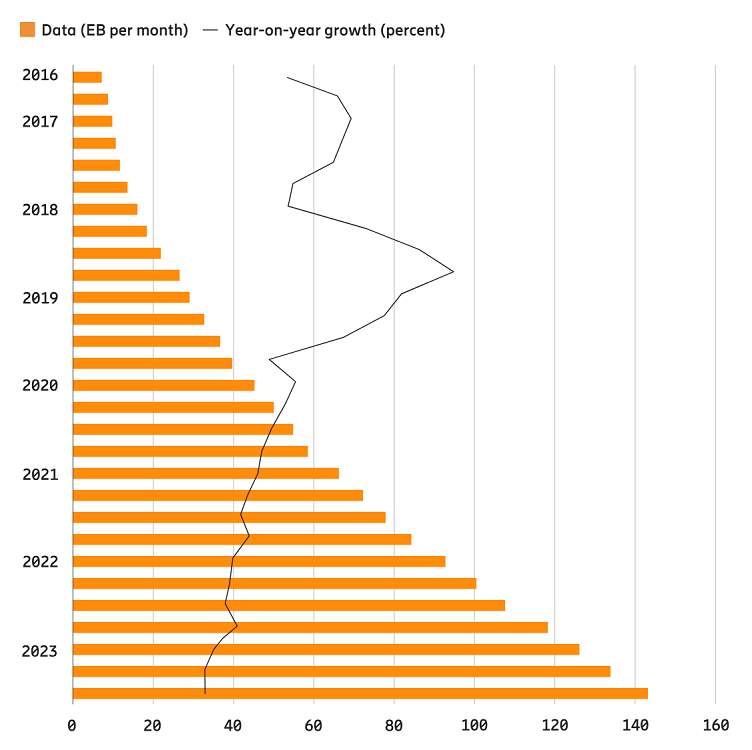
Meanwhile, 5G data rate use on global average data consumption is expected to surge from 21GB per month this year to about 56GB per month by 2029.
This is a threefold growth in mobile traffic in the next six years. Ericsson said this increase in data consumption is due to factors such as:
- Improved devices
- Increase in data intensive content
- Improved deployed networks
Ericsson said the trend of more data consumption will increase as consumers adopt 5G and new use cases emerge. Additional traffic will come from other devices other than smartphones like fixed wireless access and RedCap-enabled devices — which is designed to bring 5G services to wearables and other mobile devices outside of smartphones.
RedCap outlook
RedCap is designed to provide 5G capabilities to less complex devices that also consume less power.
While smartphones use full-featured 5G chipsets, these are unable to be placed inside devices like smartwatches, augmented reality glasses and other internet of things devices used for healthcare, asset tracking, smart home systems, fleet management and more.
Ericsson said leading service providers are already conducting trials with both data and voice over New Radio (VoNR) sessions over 5G standalone networks to test the technology on precommercial software in 2023.
With the first pre-commercial RedCap-based modules soon available, RedCap 5G devices are expected sometime in 2024 allowing a whole ecosystem of devices to be connected to 5G networks for the first time.
