
If your work intersects with the automotive industry, you’ve likely heard the acronym CASE being used to refer to a collection of top-level trends pointing toward a future-facing view of mobility. As described by innovation platform Plug and Play, CASE stands for connected, autonomous, shared and electric.
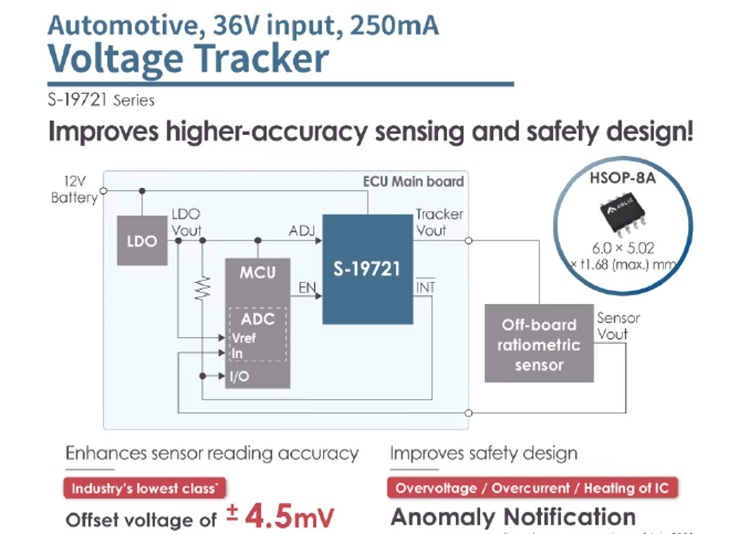
Analog semiconductor specialist ABLIC Inc. points to the second of these capabilities, autonomous driving, in discussing the importance of sensors to assess constantly changing conditions both inside and outside the vehicle. According to ABLIC, many sensors provide a ratiometric signal — an output proportional to the power supply voltage. Yet the analog-to-digital converter (ADC) in an electronic control unit (ECU) needs to have the same voltage as the sensor power supply to provide accurate readings.
Space constraints can make this challenging: The ECU is often located away from the sensor and connected to it by means of a wire harness. The sensor power supply integrated circuit, meanwhile, is located away from the power supply IC of the ADC microcontroller unit (MCU) to prevent damage to internal ECU components in the event of a wire harness failure. These separate power supply ICs can result in offset voltages, lowering reading accuracy and, as a result, compromising environmental performance, ride quality and vehicle safety.
ABLIC’s answer is its new S-19721 series of voltage trackers, which offer an offset voltage as low as ±4.5 mV to ensure accurate sensor readings. According to the company, the S-19721 is a high-withstand voltage product with an input voltage of 36 V and a rating of 45 V that can be directly connected to a 12 V lead-acid battery; it can output up to 250 mA and handle the high current output required by high-performance sensors or sensor power groups.
In addition, the S-19721 series integrates an anomaly notification function that detects anomalies and outputs them to the interrupt (INT) pin, addressing the potentials for overvoltage, overcurrent and IC thermal shutdown. Other protective circuits serve to protect ECUs in the event of wire harness failure.
Applications include power supplies for off-board sensors as well as automotive applications such as engines, transmissions and suspensions. In addition to the standard HSOP-8A package, the series can be placed in a high-heat dissipating TO-252-9S package or a compact HSNT-8(2030) package.
