

Battery electric vehicles (BEVs) account for roughly 60% of the world’s 17 million plug-in EVs. BEV growth has been nothing less than tremendous in recent years and these EVs are likely the most visible example of the shift to e-mobility and sustainable transportation.
One of the major inhibitors to even wider consumer adoption has been charge anxiety. This is the reasonable fear of being stranded without enough electrical power to get to a destination, or at least to one of the 2.3 million chargers in a still-fledgling U.S. network. However, most commutes are well within 200 miles, which is the average range of a BEV.
As one solution to charge anxiety, some automakers have equipped their vehicles with range extender (REX) technologies. Ironically, REXs are the saving grace for internal combustion engines (ICEs), although deployment is radically different than in a powertrain.
REXs add range and much more
Unlike hybrid electric vehicles that provide locomotion with an ICE, electric motor or sometimes both, most vehicles with a REX can still be classified as EVs. This is because the REX’s only output is electrical power – there are no mechanical linkages between the engine and drivetrain. Electric motors power the vehicle at all times; in fact, the REX is actually a generator.
REXs are activated by the driver and typically only needed when the distance traveled exceeds the vehicle’s nominal range, or the driver doesn’t have time or is too impatient to wait out a recharge. The REX provides supplementary DC power to the battery pack, which can provide a range extended BEV (BEVx) with 50% to 100% more range.
This provides a needed solution so manufacturers can offer inexpensive and small-sized EVs. The battery remains one of the largest and most expensive systems in any EV. With a smaller battery pack, the EV is cheaper, lighter and charges faster. REXs have become an essential technology in small, compact BEVs.
Gasoline is the most common fuel type for REXs, which seems idiomatic, yet the efficiency of a BEVx is not negated by employing fossil fuels. First, even with a REX, BEVs are much lighter. The displacement of a REX is much smaller than an ICE and is often just one or two cylinders. With no need for mechanical powertrains, the system itself is lighter and simpler.
The ICE in the REX can also operated at whatever RPM optimizes fuel economy and electrical output, which is not the case in a traditional ICE vehicle, which needs to operate over a range of RPMs, which varies the efficiency.
These principles are well illustrated in Mazda’s MX-30, where the battery fitted to the e-Skyactiv R-EV models is about half the capacity of the 35.5 kWh battery pack fitted to the standard EV, as the REX is able to provided on-demand supplementary electrical power.
That also isn’t to say gasoline is the final evolution of REX fuels, either. Fuel cells remain under research, in part due to their potential as a REX technology. It would eliminate polluting fossil fuels in favor of a sustainable fuel type, such as hydrogen or ethanol. Of course, this would require access to hydrogen or ethanol fuels, which is another challenge unto itself.
Notable REX technologies
Outside of the Opel Ampera and BMW i3, few automakers have leveraged the technology in mass-produced vehicles. However, as a new generation of clean range extenders begins to debut, opportunities are opening up.
Following the introduction of the MX-30 EV in 2021, Mazda was roundly criticized for the vehicle’s limited range of around 100 miles over the EPA cycle. Two years later the company launched the MX-30 e-Skyactiv R-EV. This is noteworthy as it marks the return of the rotary engine to Mazda’s vehicle lineup, after nearly 15 years of disuse.
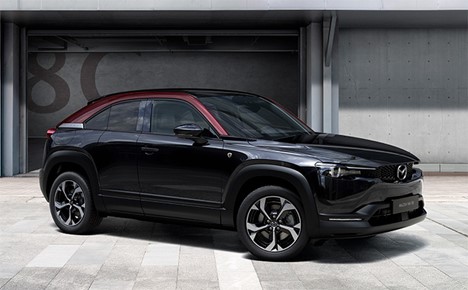 The Mazda MX-30 e-Skyactiv R-EV: Source: Mazda
Even though the MX-30 R-EV Mazda is a series plug-in hybrid, by driving the wheels full-time with an electric motor, it also qualifies as a BEVx. The paltry 17.8 kWh battery reduces the battery range to about 50 miles, but the 0.83-liter single-rotor rotary engine range extender can stretch that to over 400 miles when required.
Although the rotary engine is always a novelty, other new technologies are proving more attractive. One such solution, the micro gas turbine (MGT), is ideal for compact passenger vehicles because of its cost and physical size. And with an energy efficiency of around 30%, it is very similar to that of the spark-ignition engine.
As a range extender, the MGT produces less raw exhaust gas emissions such as HC and CO compared to the internal combustion engine. The MGT also weighs less and has the potential to further reduce CO2 levels. One such MGT range extender, known as the MiTRE (micro-turbine range extender), being developed by Delta Motorsport with support from Innovate UK, comes in two power outputs, 23 bhp and 47 bhp; is about 40% smaller; and at 50 kg, about 50% lighter than an equivalent piston engine. By increasing the size of the heat exchanger, Delta also claims a 35% improvement in the unit’s thermal efficiency.
Following Mazda’s philosophy of using the battery electric range to cover the typical daily commute, with the range extender providing extended range when needed, Delta claims excellent performance improvement from the Audi e-tron Sportback. By reducing the battery-only range to 80 miles, the battery pack capacity can be reduced from 95 kWh to 37.8 kWh, saving approximately $8,500. This also trims the mass of the vehicle by about 500 lb, including the installation of the MiTRE. Impressively, the MiTRE can run on a range of fuels, from diesel/biodiesel, compressed and liquid natural gas, landfill gases, kerosene, propane, and heating oil.
For larger, less cost-sensitive vehicles, such as commercial vehicles and large SUVs, companies such as Bosal and Ceres Power, are developing solid-oxide fuel cell (SOFC) range extenders. In these applications, efficiency is prioritized; these fuel-cell based solutions deliver around 60% energy efficiency. he metal-supported SOFC offers several other benefits including long-term reliability, fuel flexibility, low emissions, and mechanical robustness. As a range extender, the SOFC also offers fast refueling and significantly increased driving range, while reducing the installation space required, weight, and the capacity and cost of the vehicle’s battery.
The greatest drawback of the SOFC is the high operating temperature, which results in longer start-up times and mechanical and chemical compatibility issues. In overcoming these challenges, Ceres Power’s SOFC is based on its patented Steel Cell technology using cerium gadolinium oxide as the electrolyte, thereby reducing operating temperatures to between 500 and 620 °C, compared to more than 700 ˚C for conventional SOFCs using yttria stabilized zirconia electrolyte. Further, the use of a metal support allows for increased mechanical robustness, while maintaining the high volumetric power density typical of planar SOFCs.
The combination of low operating temperature - with the related ability to use lower cost materials - metal support, and careful optimization of the microstructure of the ceramic layers optimize manufacturing costs while delivering excellent performance.
Summary
REX systems will prove to be vital to the enhanced proliferation of EVs in both the small and compact vehicle segments, as well as in commercial vehicle and heavy-duty applications. There remain questions about long-term reliance on fossil fuels, as well as the ideal scenarios in which a buyer might opt for a battery-only vehicle versus as BEVx. But its clear that REX are critical to the future of e-mobility.
About the author
Peter Els is a South Africa-based former automotive engineer. This includes time with Nissan South Africa’s Product Development Division, Daimler Chrysler, Toyota, Fiat/Alfa Romeo, Beijing Automotive Works (BAW), as well as tier-one suppliers Robert Bosch and Pi Shurlok. After consulting to the local industry for 15 years, Els has ventured into technical writing and journalism about the latest trends, technologies, opportunities and threats facing the new world of mobility.
