
A recent internet of things (IoT) device and data forecast from International Data Corporation estimated that there will be 41.6 billion connected IoT devices in use by 2025, many of them portable, battery-operated devices requiring advanced battery management techniques. Ensuring their operation will require development engineers to design for peak battery performance and validate those designs against real-world results. But as anyone who works in the field can tell you, testing the run time of a physical battery in a device is a challenging and time-consuming task that can slow time to market.
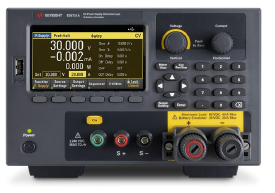 The E36731A is a battery emulation and profiling solution designed to guide better IoT device designs. Source: Keysight TechnologiesEnter the new E36731A Battery Emulator and Profiler from Keysight Technologies, which the company bills as a complete emulation solution to identify the impact of variables affecting the battery drain of IoT devices and enable design improvements.
According to a press release, the instrument addresses the battery testing needs of IoT device designers by providing an integrated electronic load and power supply that can be used to emulate battery performance. By testing with an emulated battery, Keysight says, engineers can quickly assess the effect of design or software changes on battery life by instantly transitioning the battery’s charge state. This, in turn, can guide design changes to achieve longer battery life and reduce device size.
When combined with the company’s PathWave BenchVue Advanced Battery Test and Emulation Software, the E36731A provides a solution that does all of the following:
- Generates battery profiles: The solution allows designers to establish known, good references with consistent properties that can be used over and over to simulate battery drain. Profiles can be linked to factors such as age and temperature.
- Increases battery profile accuracy: By using the simulated current drain of a device to generate battery profiles, engineers can enhance the accuracy of profiles compared to using generic manufacturer models, leading to better device designs.
- Speeds testing with battery emulation: An emulated battery allows development engineers to instantly transition a battery’s charge state and gain real-time insight into current drain. This increases efficiency and allows engineers to optimize designs for longer run time.
- Automates battery run-down and cycle testing: Test automation allows engineers to more accurately estimate battery run time and aging effects.
- Offers flexibility: The solution provides power up to 200 W, 30 V, 20 A and offers a wide dynamic measurement range from microamps to amps.
