
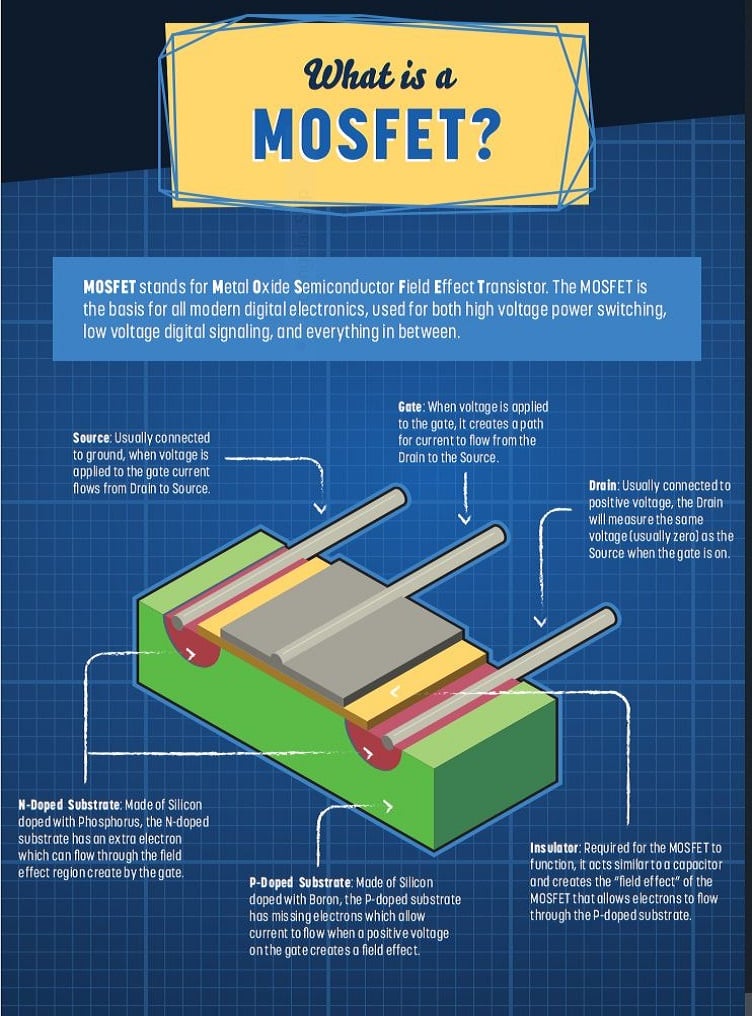
A metal-oxide-semiconductor field-effect transistor (MOSFET) is a field-effect transistor (FET) where the voltage determines the conductivity of the device. It is used for switching or amplifying signals in microprocessors and related technologies.
While MOSFETs technically have four terminals — source, gate, drain and body (or S,G,D and B) — the body terminal is typically connected to the source, effectively making them three terminal devices like other FETs. As the name implies, the MOSFET design improves upon the basic FET design by adding a layer of silicon dioxide.
A MOSFET is by far the most common transistor in digital circuits, as hundreds of thousands or millions of them may be included in a memory chip or microprocessor. Since they can be made with either p-type or n-type semiconductors, complementary pairs of transistors can be used to make switching circuits with very low power consumption, in the form of complementary metal-oxide-semiconductor logic.
MOSFETs are particularly useful in amplifiers due to their input impedance being nearly infinite, which allows the amplifier to capture almost all the incoming signal. The main advantage is that it requires almost no input current to control the load current, when compared with bipolar transistors.
Discover more about MOSFET technology and suppliers on GlobalSpec.com
