
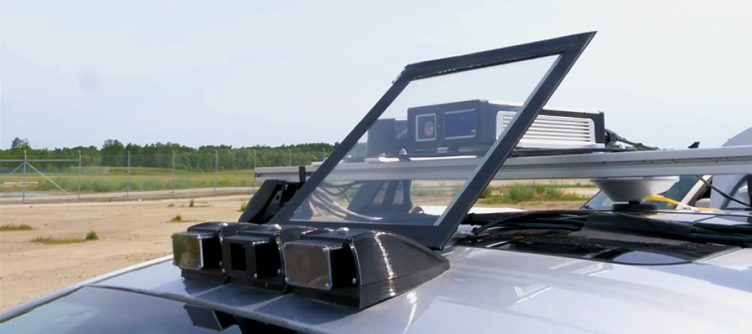
Lidar vendor AEye Inc. has tested its sensors to measure obstacles 1,000 meters in the rain, behind windshield glass.
The test was performed at the American Center for Mobility test track in Ypsilanti, Michigan, and the results were verified by automotive vehicle researcher VSI Labs.
The test indicated that not only could lidar sense objects from extremely far away, but it can also do so during adverse weather conditions and behind a surface, in this case a windshield.
The lidar was tested on a VSI research vehicle that integrated the AEye sensor into its autonomous vehicle stack to study the impact of adaptive lidar on the performance and safety of automated functionality. The rain was simulated using a rain machine and mounted the sensor behind a piece of windshield glass to gauge long-range sensor performance.
“The ultra-long-range capabilities of our adaptive LiDAR enables OEMs to release new revenue-generating applications like highway autopilot or hub-to-hub autonomous trucking,” said Jordan Greene, GM of ADAS and VP of Corporate Development at AEye. “Being able to deliver this performance in all weather conditions ensures these applications can be safely implemented in even the toughest driving environments.”
“Having already verified AEye’s extreme long-range detection, this was an important follow-up test to ensure that 1000-meter performance would stand up in less than ideal weather conditions, and when mounted behind the glass of a windshield,” said Phil Magney, founder and president at VSI Labs. “We were impressed with the sensor’s performance on both counts — which certainly bodes well for OEMs looking to implement reliable, high-performance LiDAR.”
AEye also tested its sensor mounted lidar on VSI’s test vehicle to detect small objects in a tunnel, through rain and a second surface at 120 meters. The test occurred during heavy rain with the sensor peering into a dark tunnel and was able to detect five bricks and a black dog not visible to the human eye at 120 meters as well as a pedestrian and a child at 110 meters.
