
Researchers from North Carolina State University and the University of Texas created a new approach to designing photonic devices.
The team’s new design allows developers to control the direction and polarization of light from thin-film LEDs, paving the way for the new generation of virtual reality (VR) and augmented reality (AR) technology.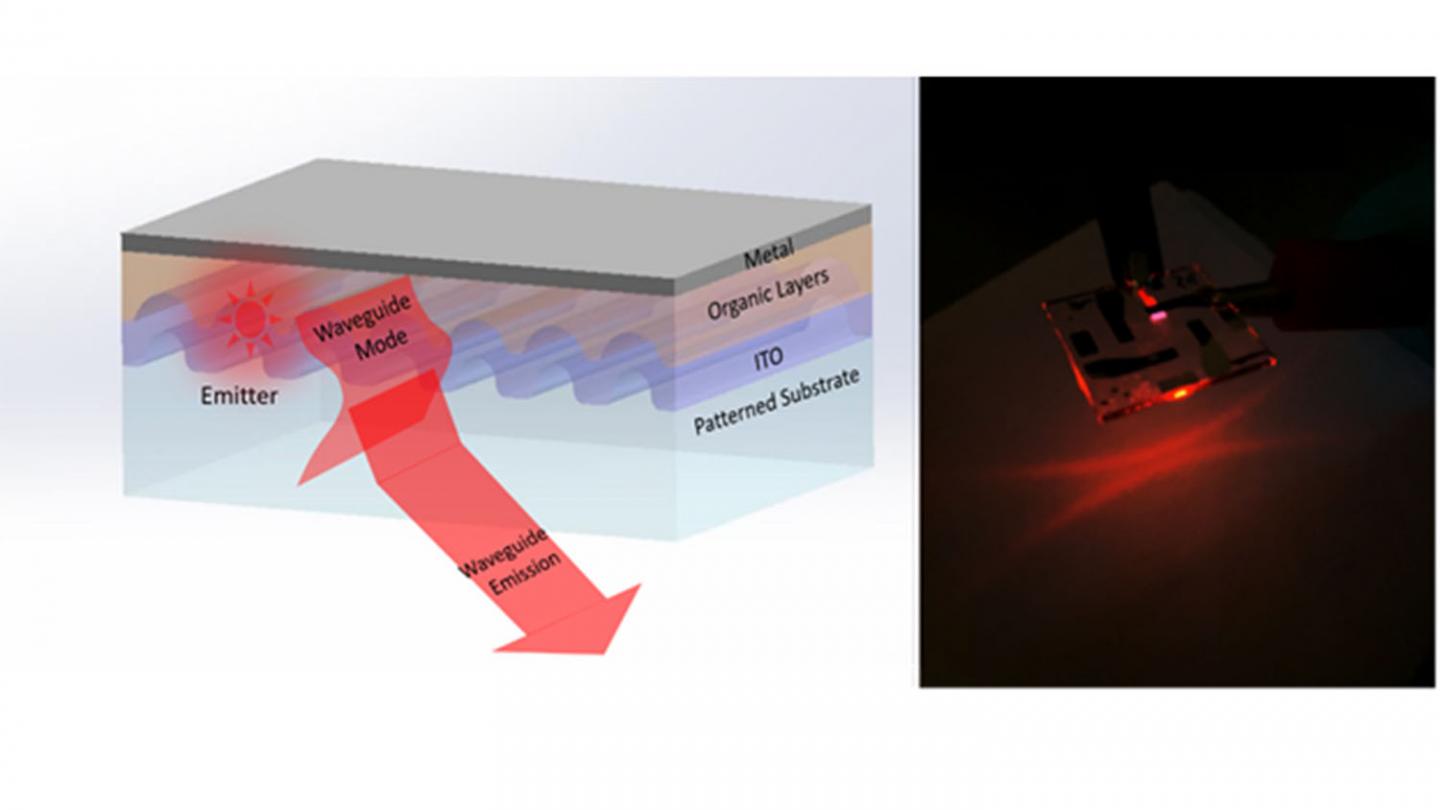 The advance allows them to control the direction and polarization of light from thin-film LEDs, paving the way for a new generation of virtual reality and augmented reality technologies.Source: Franky So
The approach allows for directional and polarized emissions from an organic LED or perovskite LED without external optical elements. It allows for directional control of light with thin-film LEDs. This makes it possible to create VR/AR headsets that are lighter and less bulky.
The improved efficiency of devices means more photons are out of the display unit for every electron put in. For AR units, this means that more light from the outside world gets through to the user, so they will be able to see the superimposed image in their view, but the real world view will be clearer.
The new design is simple to create and easy to scale up for manufacturing. Its discovery is major for OLEDs and perovskite LEDs.
A paper on the new design was published in Advanced Materials.
