
The gold award for Test & Measurement at the recent Leadership in Engineering Achievement Program (LEAP) went to resistor manufacturing company Riedon, for its SSA smart shunt series. LEAP celebrates innovative and forward-thinking products in the design engineering space and the awards honor designs in 12 categories.
The product line is comprised of current-sensing modules designed to combine the attributes of conventional passive shunt resistors with those normally associated with closed-loop hall effect current sensors, which can be bulky and considerably more expensive.
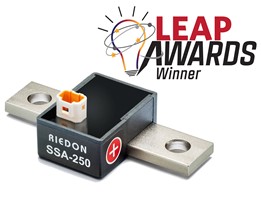 Riedon’s SSA smart shunt took the gold at the LEAP Awards. Sources: Riedon, WTWH MediaThe LEAP Award judges, an independent panel of 14 engineering and academic professionals, had this to say about the SSA smart shunt: “A major product footprint shrink, more stable over temperature, major increase in measurement accuracy lives up to the claim of ‘game changer.’ Easy installation and integration of the measurement system is a winning combination.”
Riedon claims the SSA smart shunt includes the following advantages over hall effect technology such as:
- Superior overall current measurement accuracy
- Unipolar power supply
- Lower temperature drift
- No periodic calibration
- Higher operating temperature range
Phil Ebbert, vice president for engineering at Riedon, said that hall effect sensors previously have been a preferable choice for challenging current measuring applications, citing their qualities of being non-intrusive, possessing intrinsic electrical isolation and supporting higher voltages. However, there are clear drawbacks, Ebbert said, such as the impact of electromagnetic fields and temperature fluctuations on their accuracy. While standard shunt resistors offer more accurate and operationally stable parameters, he adds, their non-isolated nature has held back their widespread deployment.
The real innovation of the SSA smart shunt is their integration of isolation amplifiers, which offer reinforced electrical isolation up to 1500 V DC.
Applications include battery systems, uninterruptible power supply (UPS) systems, motor drives, frequency inverters and fuel cells. Engineers considering shunt solutions as an alternative to Hall Effect sensors may also want to consider this comparison produced by Texas Instruments, which looks specifically at applications in electric vehicles (EVs) and hybrid electric vehicles (HEVs).
For more information on winners of the 2020 LEAP Awards, visit WTWH Media publication Design World.
