
A new solid-state, high-resolution, long-range digital lidar sensor has been introduced by Ouster and designed as a low-cost option for advanced driver assistance systems (ADAS) and industrial automation.
The ES2 sensor, manufactured on standard CMOS technology, uses electronic scanning to fire an array of over 10,000 lasers onto a single chip. The lasers are paired with a custom digital detector array capable of counting trillions of individual photons every second. With thousands of lasers on the chip fixed on a different point in the field of view, no moving parts are required to reach the range, field of view and resolution targets, Ouster said.
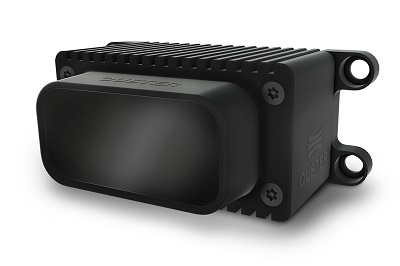 The solid-state lidar sensor has no moving parts. Instead it uses electronic scanning to fire an array of thousands of lasers on a single chip. Source: OusterOuster said it plans to build the ES2 sensor in its high-volume production line that is operating at its overseas manufacturing facility. The lidar sensor will debut with a maximum range of more than 200 meters on a 10% reflective surface.
“When you see a technology category turn from analog to digital, the transition can take some time, but the outcome is always the same,” said Pierrick Boulay, part of Yole Développement’s photonic and sensing team. “Analog products create markets, but digital products dominate them. Digital lidar is a clear path to inexpensive, widespread and high-performance 3-D imaging that is required for all types of autonomous solutions in automotive, robotics and industrial automation.”
Ouster said the ES2 sensor is fully certified for cybersecurity, shock and vibration, thermal cycling, ingress protection and automotive grade standards including ISO 26262, SIL-2 and ASPICE.
Ouster said it is developing the lidar sensor and expect sampling to be available in 2022 with volume production expected in 2023. The company said this fits the timeline to match automotive OEMs' plans for adding ADAS applications and other automotive standards for self-driving and partially automated driving vehicles.
