
Researchers at George Washington University and Northwestern University have developed a new class of soft devices that can provide expanded functionality for catheters used in cardiac procedures. The new materials are soft electronics, including stretchable sensors and actuators, that when applied to the surface of a catheter system, could greatly assist in diagnosing and treating cardiac conditions.
Catheters now used in minimally invasive procedures are rigid and do not conform well to soft tissues, frequently necessitating the use of multiple probes or extending the procedure duration in order to obtain the 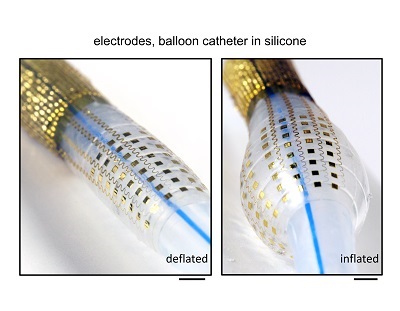 Source: George Washington University and Northwestern Universityrequired electrophysiological data. The new catheter design conforms well with soft tissues, making it easier to access and treat cardiac conditions while reducing the time required for each procedure.
The incorporation of soft electronics, such as temperature and pressure sensors, allows the instrument to analyze the tissue around itself. The electronic arrays facilitate high-density spatiotemporal mapping of temperature, pressure and electrophysiological parameters and allow for programmable electrical stimulation, radio frequency ablation during which cardiac or nerve cells are burned to eliminate sources of arrhythmia and irreversible electroporation for delivery of drugs directly into cells.
Integrating multimodal and multiplexing capabilities into these minimally invasive surgical instruments may improve surgical performance and patient outcomes.
