
New Vision Display (NVD) is pleased to announce its recent acquisition of ZBD bistable display technology, which included ZBD intellectual property, know-how, an R&D facility and a number of employees. The facility located in Malvern, U.K., offers additional customer service, initial failure analysis, meeting room/facilities, research and prototyping operations, and a cleanroom laboratory.
Bistable displays have been in existence for decades (e-paper and cholesteric LCDs), but until recently 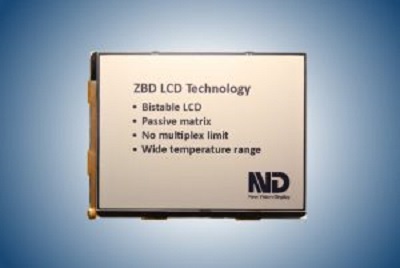 Source: NVDhave been impractical for many applications due to several technology-based weaknesses. ZBD LCDs are a type of bistable display that is based on conventional passive matrix LCD technology. Invented in the 1990s and historically employed in electronic shelf labels, the demand for ZBD displays is growing in applications where e-paper or cholesteric LCDs can only function to a limited extent: Outdoor signage, parking meters, ticket/vending machines, smartwatches, key fobs and more. ZBDs are an ideal solution for battery-operated devices, outdoor environments and bright lighting conditions.
ZBD displays offer many key advantages over other types of bistable displays. First, ZBD displays can utilize common passive matrix LCD controller ICs, which are inexpensive, easy to drive and available on a long-term basis. Second, ZBD LCD development and NRE costs are comparable to that of super-twisted nematic (STN) displays, making it possible to provide customer-specific formats and resolutions at much lower tooling costs and MOQs than is possible with TFT LCDs. In fact, ZBD display structure only differs from standard STN-type displays by one modified internal surface (an ideal complement to NVD’s existing passive LCD production lines). Third, ZBD displays do not suffer the multiplex limitations of STN displays. With ZBDs, there are no limits to how many lines can be addressed and very high resolutions are possible without loss of contrast or viewing angle. Currently, ZBD displays of up to 14 in sizes are being produced with 200 dpi, which is comparable to high-resolution thin-film transistors. Fourth, the ZBD technology requires no power to maintain the image on the display after the switching process, making them extremely low power.
Other key ZBD display features include paper-like reflectivity, wide viewing angles, sunlight readability, wide storage/operating temperatures and long-term stability at a low cost. Images can be switched perfectly at up to 85° C and remain artifact free at greater than 100° C. The display image can be switched down to -10° C, and can maintain the image in as low as -40° C. Furthermore, NVD can customize them with color-printed areas behind the images, and/or laminate them with decorative or protective cover lenses. Because the technology is purely reflective, it must be illuminated from the front using either ambient light or a front light-guide, which is a factory-fit option provided by NVD.
