
A diminutive implantable pacemaker has been designed for use in small animal models crucial for studying cardiovascular disease progression and prevention. The wireless, dime-sized device enables chronic pacing of 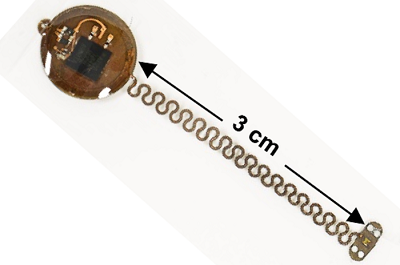 The wireless pacemaker supports optical and electrical multisite stimulation. Source: I. Efimov/George Washington Universityfreely moving animals and is compatible with MRI and CT imaging.
Animal testing confirmed the feasibility of the miniaturized pacing platform design. The 110 mg pacemaker demonstrated capabilities for subdermal implantation and tolerance to over 200,000 multiaxial cycles of strain without degradation in electrical or optical performance. Experiments also successfully achieved multisite pacing, a modality required to induce synchronous multimodal pacing for different heart failure models, which is clinically used for resynchronization therapy.
The significant weight and size reduction realized by eliminating the need for a battery might in the future translate into the design of compact wireless pacemakers for humans. The availability of a tiny, lightweight device would enable doctors to place several pacemakers across the heart in a treatment that can improve the quality of resynchronization therapy and improve patient comfort.
The research conducted by scientists from Northwestern University, University of Arizona, George Washington University, Dalian University of Technology (China) and Tsinghua University (China) is published in Nature Communications.
