
Sponsored Content
Machinery
Lasers in schools and makerspaces
04 November 2019
Picture if you will a teacher in a science classroom explaining the principles behind lasers. The lesson is certainly relevant: Lasers are used in everything from reading barcodes to printing documents to performing surgery. It is also timely: The year 2020 marks the 60th anniversary of the device’s appearance on the scene. The theory behind the laser also drew upon physicist Max Planck’s work around understanding electromagnetic radiation, a pioneering insight of modern physics and quantum theory that marks its own 120th anniversary in 2020.
The teacher has two different options for illustrating the lesson’s subject: chalkboard sketches and textbook drawings — or a demonstration with an actual laser. An easy choice, perhaps, if the school has access to one.
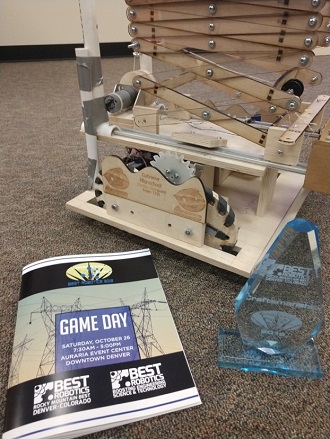 Figure 1: This award-winning robotic scissor lift was constructed with pieces cut by an Epilog laser. Source: Gateway High SchoolNowadays, many do. In addition to the broad range of applications for a laser in an educational setting — from artistic realization to architecture modeling to technology instruction — the devices are more affordable than one might imagine. A technology instructor made purchasing an Epilog laser a reality for his small-town Pennsylvania high school, for instance, noting that the system has been used for creating awards and saleable items for fundraising. An Epilog laser has also been used to expand the offerings of a vocational tech center in a rural area of West Virginia, and to build business skills into the curriculum of a juvenile corrections program in Salem, Oregon.
Closer to Epilog’s home base in central Colorado, Andrew Woods, a Project Lead the Way (PLTW) instructor at Gateway High School in Aurora made acquisition of a laser a top priority for building a career and technical education program. “Everyone kind of said, ‘3D printers. Have you gotten 3D printers yet?’” he recalled. “I put off buying 3D printers as long as I could. But the first chance I could, I wrote a grant to get the laser engraver.” Woods noted that, while there is an established foundation for laser technology, ongoing developments in 3D printers have resulted in a smaller return on investment. “The 3D printers that we bring in today are going to be obsolete next week,” he said.
Gateway’s laser, a 50-watt M2 Fusion model, was purchased four years ago and currently resides in the architecture drafting lab where it gets used by a wide range of students. The woodworking class uses it to etch designs onto the surfaces of its creations. A class in aerospace engineering uses it to cut out wings for balsa wood gliders and rocket fins. And the introductory engineering design class cuts out pieces of Masonite for its end-of-term project, an automata: Woods explained that this is a box with a cam gear handle on its side, similar to a music box; rotations of the handle are translated from the cam to a follower, producing vertical movement.
But Woods gets most excited talking about his afterschool robotics program. “We’re given various material like sixteenth-inch polyacrylic and quarter-inch plywood, and the students then use the laser to cut out the parts.” Recently, his students entered a local competition with the theme of post-disaster power restoration and debris clean-up; the team’s robotic scissor lift, with a range of just over 4 ft, won an award for craftsmanship and will next be entered into a regional competition.
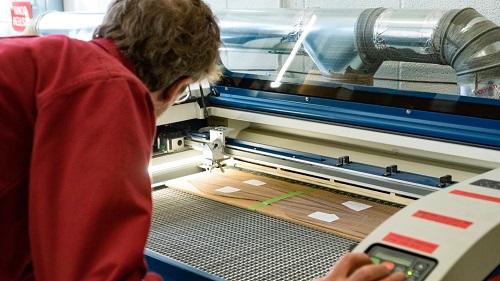 Figure 2: Preparing to cut/engrave wood on a Fusion M2 at BLDG 61: Boulder Library Makerspace, in Boulder, Colorado. Source: Epilog Laser
Of course, the laser’s utility as an educational tool extends beyond the school walls. The rise of makerspaces around the world has made the devices accessible to a wider segment of interested hobbyists and entrepreneurs, who prove that learning need not stop once formal education ends.
Lasers are among the key equipment purchases for establishing a fab lab — a carefully prescribed type of makerspace devoted to teaching novices how to make things. Fab labs provide free or low-cost access to a core set of tools and an introductory design and engineering curriculum. Since their inception, the facilities have played host to a variety of activities including peer-to-peer technical training, small-scale business incubation and grassroots research. There is also a school-focused offshoot of the program, FabLearn Labs, which is geared at putting cutting-edge technologies into the hands of K-12 students.
The fab lab network grew out of a maker course held at MIT in 2005; a nonprofit foundation to facilitate and support its growth internationally, the Fab Foundation, emerged in 2009. Perhaps most notably, the equipment list for establishing a fab lab includes recommendations on CNC machines, vinyl cutters, 3D printers and lasers — of which the Epilog Mini24 is considered standard equipment.
Outside of the fab lab network, makerspaces can take a for-profit approach, or a cooperative corporate approach in which profits are distributed based on member participation. In this context, access to laser equipment can be a major draw for building a customer base or establishing incentives for membership renewals. Epilog cites this as just one of several reasons that lasers are likely to be the most popular tool in a makerspace.
The laser is a highly versatile tool with applications in a wide range of settings where learning happens. In addition to its capabilities as a precision piece of production equipment, the laser’s value extends into the sparking of creativity, the inspiration to follow new and unexpected career paths, and the foundation of lifelong learning.
Powered by CR4, the Engineering Community
Discussion – 1 comment
By posting a comment you confirm that you have read and accept our Posting Rules and Terms of Use.
#1
GaryGoldstein
2020-Jul-15 7:13 AM
Very interesting and unusual, the presence of such a laser used to be a rarity. Although I personally would like to get such an experience, before it was unlikely. Over the past decade, everything has changed a lot in every area of our lives.
Advertisement
Advertisement
Popular News
Find Free Electronics Datasheets

Advertisement