
The ability to simulate cardiac arrhythmia dynamics could lead to personalized treatments for heart patients. Such complex computer analyses require extensive and time-consuming parameter sensitivity studies and accessibility to requisite expertise and supercomputer systems. A new approach developed by researchers from Georgia Institute of Technology and Rochester Institute of Technology enables use of conventional web browsers or even smartphones to conduct high-performance cardiac dynamics simulations.
The streamlined method uses graphics processing chips designed for gaming applications, available software 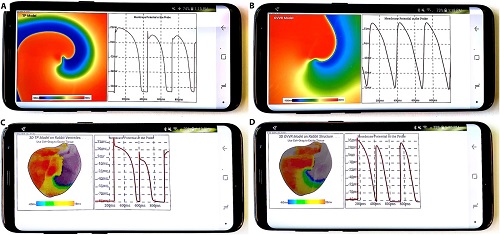 High-performance simulations on a Galaxy S8 smartphone. (A and B) 2D spiral wave and (C and D) 3D reentry in rabbit ventricles with two different models. Up to 1.7 billion ordinary differential equations can be solved per second using this phone. Source: A. Kaboudian et al.and a fast, simple library using Web Graphics Library (WebGL 2.0). Real-time simulations can be performed in 3D by clinicians and researchers to improve diagnosis and treatment of cardiac issues, evaluate pharmaceuticals and other therapy options and tailor interventions for individual patients.
Multiple processors in graphics processing units (GPUs) support running problems in parallel as a supercomputer does, and simulations can be performed thousands of times faster than with standard central processing units. The programming library developed in WebGL is available for use with Chrome and other web browsers. Ten models based on WebGL programming have been developed to date and are expected to be made available to interested researchers.
The researchers demonstrated that personal computers were able to solve up to 40 billion differential equations per second for cases based on animal model ventricular cells using the proposed methodology, which is described in Science Advances. Future enhancements will include the ability to run simulations on more than one GPU card to achieve even higher computational speeds.
