
The simple cane widely used as a mobility-assistive device by patients undergoing physical rehabilitation is on the verge of becoming smarter. Pressure sensors incorporated by researchers from Mälardalen University, Sweden, and University of Malaga, Spain, detect the load placed by the user on the cane, providing data for 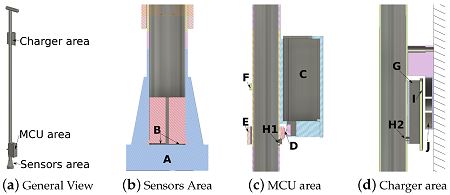 Design overview: (A) rubber tip; (B) force sensors locations; (C) microcontroller (MCU) box; (D) connectors between charger-sensors and MCU; (E) connector ring; (F) clamp for MCU box; (G) battery and charger box; (H1) hole to wires from charger and sensors areas to MCU box; (H2) hole to wires from MCU box to charger area; (I) charging receiver location; and (J) charging transmitter location. Source: University of Malagacontinuous analysis of gait.
The embedded pressure sensors are placed at two different depths in the tip of a wirelessy charged cane so that they don't affect cane ergonomics. Speed and load data are transmitted by Bluetooth to the user's smartphone and to the clinician’s computer. Special algorithms determine if the user is still largely reliant on the cane for support while walking, or if the need for this assist is diminishing. The cost of the proposed system, which requires only minor modifications to the cane, is under $100.
When tested by volunteers who require a cane for mobility, the smart cane was demonstrated to provide continuous load monitoring without affecting cane ergonomics. The load on the cane was shown to be correlated with gait speed, which is a clinically reported condition estimator.
The 3D models and microcontroller software used to engineer the cane are publicly available, and the research is published in the journal Sensors.
