
Radio-frequency identification (RFID) tags are intelligent bar codes that link to a networked system to track the whereabouts of hospital patients, airline passengers and products through the supply chain. Incorporated into a smart coaster, the technology can also alert your bartender or waiter for a beverage refill.
The electronic tagging technology has now been applied to study the behavior of hummingbirds at feeding stations in urban areas. Congregating at feeders is not a natural behavior for these birds, who tend to make 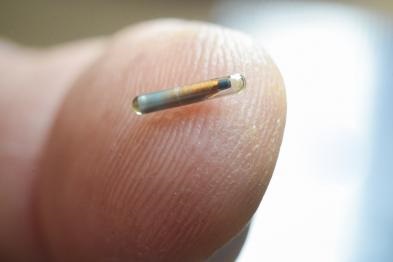 PIT tags inserted under hummingbird skin provide insight into their movements and behaviors. Source: Don Preisler/University of California-Davislittle contact with each other in the wild. Researchers are using RFID to assess possible changes in population dynamics, and implications for disease transmission, associated with visits to feeders in cities.
More than 200 specimens of Anna’s and Allen’s hummingbirds were fitted with 8 mm long passive integrated transponder (PIT) tags, and their visits to seven feeding stations at three California sites were monitored. The feeders were equipped with commercially available antennae and RFID transceivers.
About 118,000 feeding station visits were recorded during September 2016 to March 2018, and more than 60% of tagged birds were observed to return at least once. Visits were more numerous during morning and evening periods in spring and summer, and females were observed to remain longer than males.
The RFID-feeding station setup could have extensive applications in assessing local and regional migration patterns, habitat and landscape effects on survivability, and transmission of infections within populations. It might also be used in studies designed to help establish recommendations for best feeding practices for hummingbirds and help maintain healthy populations living in urban areas.
Researchers from Wild Wings Ecology, U.S. Fish and Wildlife Service and the University of California-Davis contributed to this study, which is published in PLOS ONE.
