
In what may seem like the largest assemblage of automatons focused on a single astronomical task, 5,000 robots are being constructed to monitor millions of galaxies and provide insights on the nature of dark energy.
The Dark Energy Spectroscopic Instrument (DESI) project underway by researchers from the U.S. Department of Energy’s Lawrence Berkeley National Laboratory will measure the effect of dark energy on the expansion of 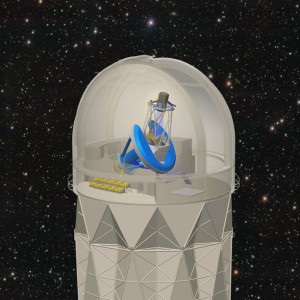 DESI will be mounted on the Mayall Telescope at Kitt Peak National Observatory. Source: R. Lafever and J. Moustakas, DESI Collaborationthe universe. Optical spectra obtained for galaxies and quasars by the automatic adjustment of the robotic fiber optic positioners will be used to construct a 3D map spanning the nearby universe to 11 billion light years.
The robots will be housed in an array of 10 wedge-shaped petals to form a circular focal plane, planned for deployment near the top of the Mayall Telescope at Kitt Peak National Observatory near Tucson, Arizona.
New corrector optics provide a 3-degree-diameter field of view that feeds the focal plate containing 5,000 robotic positioners. The positioners can be reconfigured within three minutes to measure the spectra of a new set of galaxies. Optical fibers mounted to the positioners will extend 50 m down the telescope to feed 10 broad-band spectrographs, each containing three detectors. The spectrographs will cover a spectral range of 360 to 980 nm with a resolution of 2,000 to 5,000, enabling DESI to probe redshifts up to 1.7 for emission line galaxies and 3.5 for the lyman-α spectra from quasars.
