
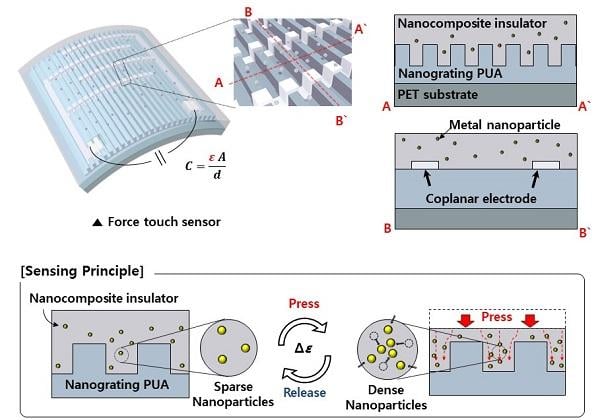
 Schematic illustration of a transparent, flexible force touch sensor (upper image) and sensitivity enhancement by using stress concentration (lower image). Source: KAIST
Developers from KAIST have created a high performance, transparent, nanoforce touch sensor that can be mass produced and that works effectively with wearable technologies. The new sensor is based on thin, flexible, transparent hierarchical nanocomposite (HNC) film. The film is what allows the sensor to move with the wearable device and last for long periods of time. The new sensor has all of the characteristics necessary for industrial uses, overcoming the issues that flexible sensors have had in the past.
Force touch sensors can recognize the location and pressure of external stimuli. These kinds of sensors are best used for wearable devices, flexible displays, humanoid robots and more. Even after years of development, these sensors still have challenges that are preventing the sensors from being widely used. For example, the sensor’s performance is subject to change and degrade from mechanical stress when the device is bent.
The KAIST team set out to overcome development issues. They created non-air gap sensors that are different from the conventional technology. Flexible sensors need air gaps so air can flow between electrodes in order to achieve the high sensitivity and flexibility required for wearable devices.
The new sensors are based on a transparent nanocomposite insulator. This insulator has metal nanoparticles that maximize the capacity of change in dielectrics due to pressure. The particles also have nanograting substrate to increase the transparency.
The resulting sensor overcomes all issues that developers have faced in the past. It can be mass produced and stay at the same performance level over time and under pressure.
The sensor was tested on a wearable device to track a patient’s heartbeat. The testing proved that the sensor can operate well in real life.
The paper on this new technology was published in Advanced Functional Materials Journal.
