
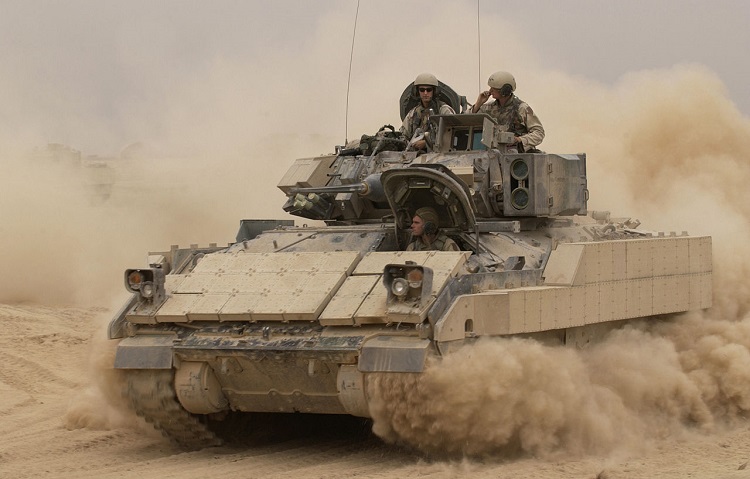
 An M2A2 Bradley Fighting Vehicle. Source: Shane A. Cuomo, U.S. Air Force
Honeywell and the U.S. Army are testing a prototype of an advanced helmet-mounted vision system in the Bradley Fighting Vehicle, one of the U.S. Army's most notable ground vehicles.
The U.S. Army Research, Development and Engineering Command's Ground Vehicle Systems Center (TARDEC) has successfully tested the prototype vision system at Camp Grayling, Michigan, and user testing will continue at Fort Stewart, Georgia, in the coming months. Named the Ground X-Vehicle Technologies (GXV-T) Crew Station Augmentation Concept, this technology is augmented by an existing suite of 360-degree awareness sensors that will collectively deliver a more comprehensive and mission-effective driving experience for combat vehicle operators.
New U.S. Army ground vehicle programs could leverage this capability to enhance soldier protection while allowing remote monitoring and control of robotic and optionally manned vehicles. This would enable vehicle operators to drive, navigate and control multiple vehicles, while also keeping a human in the loop for assured control.
The helmet-mounted vision system includes a range of forward-facing cameras that deliver imagery projected into the left and right eye of the user through a pair of holographic optical elements. The approach allows operators to perceive depth in the imagery while showing a wide field of regard without causing nausea or eyestrain. The ability to simulate direct-sight conditions in a way that mimics natural viewing is a key factor in achieving fully operational, closed-hatch driving. The helmet-mounted system also allows a combination of other cameras to relay views from other angles around the vehicle, so operators have awareness beyond what is directly in front of them.
The installation of the prototype on the Bradley Fighting Vehicle is the first of several steps to demonstrate the proof-of-concept and effectiveness of the advanced helmet-mounted vision system. The technology is scheduled to continue testing throughout 2018.
