
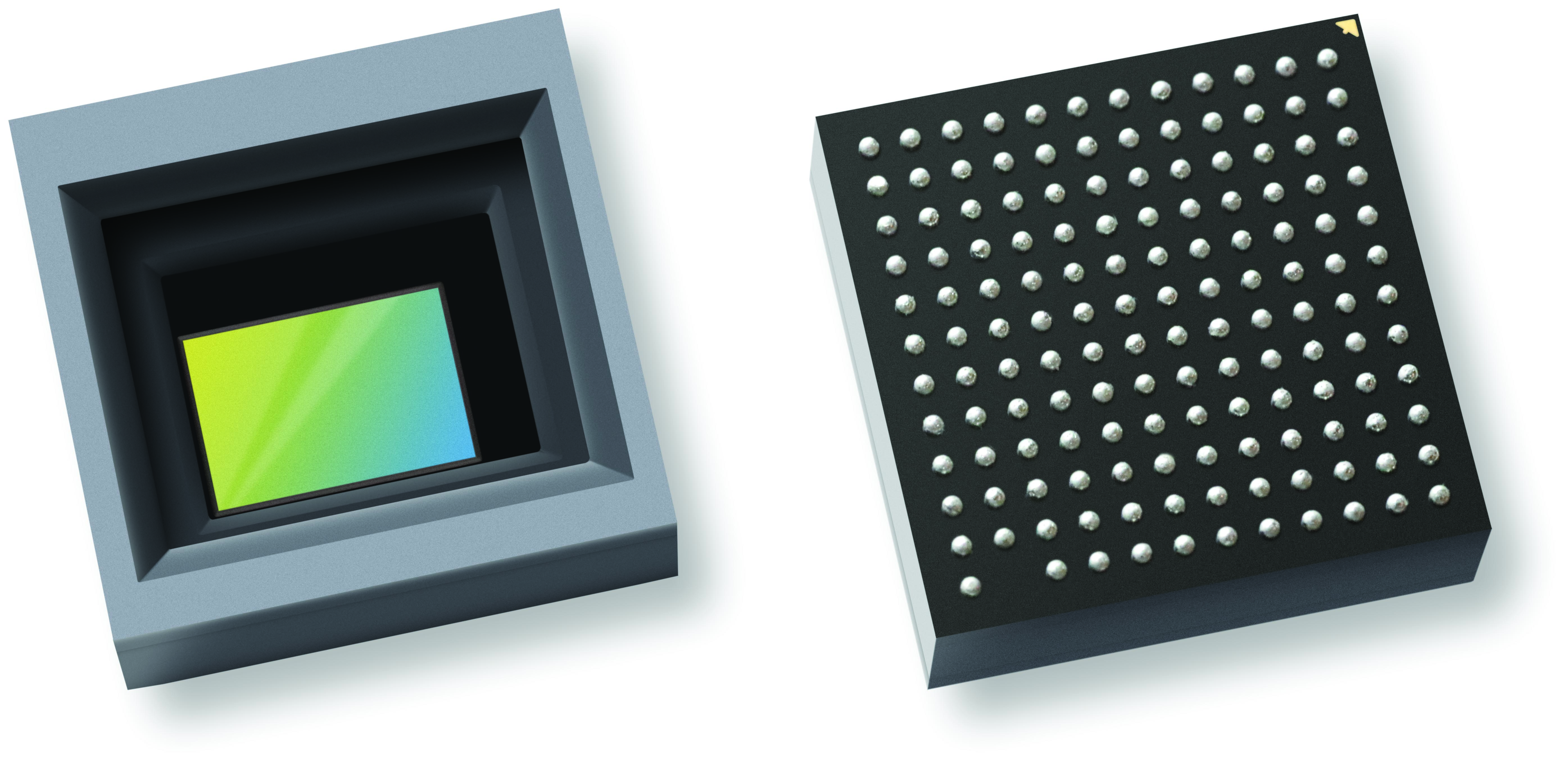
 OmniVision, Texas Instruments and Leopard Imaging collaborated on the automotive industry’s first HD camera module to fit all its components on a single PCB, including the OmniVision OX01B40 image sensor plus image signal processor system-in-package that is shown here. Source: OminiVision Technologies
OmniVision Technologies Inc., has announced its high definition (HD) automotive camera module reference design, developed with collaboration from Leopard Imaging and featuring technology from Texas Instruments (TI). The compact design includes OmniVision’s OX01B40 image sensor plus image signal processor (ISP) system-in-package (SiP), as well as TI’s DS90UB933-Q1 or DS90UB935-Q1 serializer chip and TPS65000-Q1 power management integrated circuit (PMIC).
The reference design can be integrated directly into vehicles as a low-cost solution with the fastest time to market, or the design can serve as a starter kit for Tier-1s and OEMs (original equipment manufacturers) who want to create their own camera modules.
The new reference design was created to help customers in designing automotive viewing cameras, especially rearview cameras or surround-view cameras. This is the first automotive camera module to incorporate all its components on a single printed circuit board (PCB).
OmniVision’s OX01B40 SiP combines a 1392 x 976 resolution color CMOS image sensor and an ISP. It supports streaming video of up to 60 frames per second (fps) and consumes less than 400 mW of power. Built on OmniVision’s 2.8-micron OmniBSI-2™ Deep Well™ pixel technology, the OX01B40 delivers low-light sensitivity and 120 dB high dynamic range (HDR) performance for excellent contrast and for resilience to rapidly changing lighting conditions ranging from darkness to bright sunlight.
Handling the power needs in the design, TI’s TPS65000-Q1 single-chip PMIC combines low-dropout regulators with a step-down converter that can operate in forced PWM mode or auto PWM-PFM mode, depending on load, to maximize efficiency. This reference design also offers the choice of either parallel CMOS (DS90UB933-Q1) or MIPI CSI-2 (DS90UB935-Q1) FPD-Link serializers, both of which support communication with high-speed image sensors. The DS90UB935-Q1 removes the need for an oscillator in the camera module, minimizing cost and space while providing reliability.
Learn more about the reference design on the Leopard Imaging website.
