The stiffness of arteries is an important indicator of cardiovascular health, but this parameter is somewhat difficult to evaluate and requires complex equipment and invasive procedures. Now, a new method developed by researchers at USC Viterbi School of Engineering offers a better way. By coupling a machine learning model with a patient’s pulse data, they are able to measure a key risk factor for cardiovascular disease and arterial stiffness, using just a smartphone.
Clinicians determine arterial stiffness by measuring pulse wave velocity (PWV), which is the speed that the arterial pulse propagates through the circulatory system. Current measurement methods include MRI, which is expensive and often not feasible, or tonometry, which requires two pressure measurements and an electrocardiogram to match the phases of the two pressure waves.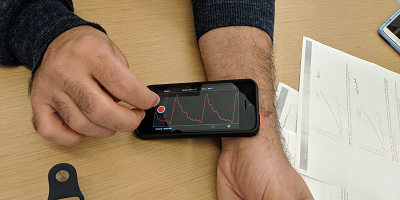 The iPhone app captures a pulse wave using just the phone’s camera. Source: Ashleen Knutsen
The new approach instead uses a single, uncalibrated carotid pressure wave that can be captured with a smartphone’s camera. In a previous study, the team used the same technology to develop an iPhone app that can detect heart failure using the slight perturbations of the pulse beneath the skin to record a pulse wave. The technology has now been applied and is able to determine arterial stiffness.
Instead of a detailed waveform required with tonometry, the method needs just the shape of a patient’s pulse wave for the mathematical model, called intrinsic frequency, to calculate key variables related to the phases of the patient’s heartbeat. These variables are then used in a machine learning model that determines PWV and, therefore, arterial stiffness.
Existing tonometry data collected from the Framingham Heart Study, a long-term epidemiological cohort analysis was used to validate the technique. Using 5,012 patients, they calculated their own PWV measurements and compared them with the tonometry measurements from the study, finding an 85 percent correlation between the two.
This machine learning method captures clinically significant outcomes due to the intrinsic frequency algorithm, which is the mathematical analysis used to calculate physically relevant variables relating to the patient’s heart and vascular function. The main variables represent the heart’s performance during the contraction phase (systole) and the vasculature’s performance during the relaxed phase (diastole).
The researchers plan to expand on the intrinsic frequency algorithm so that it can be applied to a number of other applications, such as detecting silent heart attacks.
The research is published in Scientific Reports.
