
The European Union-funded CARDIS project consortium has designed a prototype portable, low-cost device based on silicon photonics for the rapid measurement of arterial stiffness and diagnosis of stenosis and heart failure. Arterial stiffness is gauged by analysis of aortic pulse wave velocity: the speed at which a person’s blood pressure pulse circulates around the vascular system. That stiffness, caused by the buildup of plaque 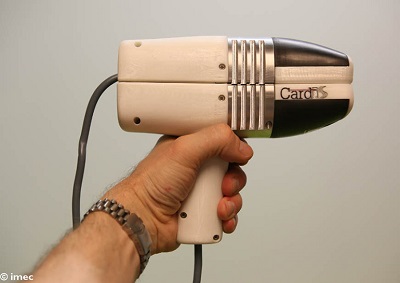 The device performs Laser Doppler Vibrometry on a patient’s skin to deduce metrics for arterial stiffness and to diagnose cardiovascular diseases. Source: Imecinside an artery, is seen as a major risk factor but is difficult to measure.
The point-of-care screening device for cardiovascular disease (CVD) is based on Laser Doppler Vibrometry (LDV), which involves a low-power laser directed toward the skin above an artery. The Doppler shift of the reflected beam is analyzed to measure the skin’s vibration amplitude and frequency caused by the heartbeat. Two rows of six beams enable simultaneous scanning of multiple points on the skin overlying the artery, and a silicon photonics chip provides the optical functionality of a multi-beam LDV device.
The photonic tool was trialed in a clinical feasibility study involving 100 patients at the Georges Pompidou European Hospital in Paris. The quality of the device readings was good and adequate measurement results were observed in all subjects. The partners are planning for additional clinical feasibility studies of the device at the Academic Hospital of Maastricht in the Netherlands. The handheld LDV equipment could provide an easy and non-invasive way to screen large numbers of patients for undiagnosed CVD, something that no other tool can currently provide.
Project partners include Imec (Belgium), Medtronic, SIOS Messtechnik GmbH (Germany), Tyndall National Institute (Ireland), Ghent University (Belgium), INSERM (France), Queen Mary University of London (UK), Maastricht University (the Netherlands) and Fundico (Belgium).
