
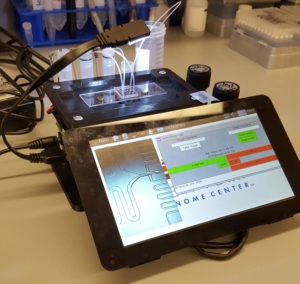
 The portable, low-cost microfluidic device identifies cells that may prove to be important drug targets. Source: NYGC
Single-cell analysis offers great potential to study how individual cells influence disease and respond to treatment, but the lack of cost-effective and user-friendly instrumentation remains challenging. A new 3D-printed, portable and low-cost microfluidic controller can now provide access to single-cell sequencing. Researchers from New York Genome Center (NYGC) and New York University demonstrated the clinical utility of the system by analyzing synovial tissue from patients with rheumatoid arthritis (RA).
The 3D-printed custom device and its electronic and pneumatic components are easily obtained and assembled for a total cost of about $600, a fraction of the cost of comparable commercial systems. The compact, tissue box-sized instrument performs droplet microfluidics and in particular Drop-seq, a massively parallel technology for single cell RNA-sequencing.
The portability of the controller permits patient samples to be processed on-site and immediately after surgery, minimizing handling and transport to optimize sample quality. The researchers collected samples from five RA patients totaling 20,387 cells and examined individual gene expression patterns for each cell.
By analyzing this complete dataset and searching for clusters of similar cells, the researchers identified 13 groups, representing both infiltrating immune and inflamed stromal populations. Of particular interest were distinct groups of fibroblasts with strikingly different gene expression patterns. Previously unrecognized fibroblast subtypes were classified that may prove to be important drug targets for RA patients. The presence of these multiple groups was validated using flow cytometry, revealing that they exhibited distinct localization patterns with the joint tissue as well.
The dataset is a step toward creating a comprehensive “cell atlas” for synovial tissue from RA patients. The researchers are now compiling data from additional RA patients, and envision that technology will be useful for profiling samples that are difficult to study in a standard lab, such as highly infectious samples in biocontainment facilities or samples being collected in field research settings. To facilitate its widespread use in the scientific and medical community, the instrument has been fully open-sourced. Instructions and assembly manuals for the instrument can be found online at the popular microfluidics repository Metafluidics.
The research is published in the journal Nature Communications.
