
An international team led by researchers from Universidad Carlos III de Madrid, Spain, is developing an autonomous underground robot with intelligent navigation for urban environments. The system, developed within the framework of the European research project BADGER (roBot for Autonomous unDerGround trenchless opERations), aims to become a model for excavation technologies because of its high economic and social impact.
The system is being designed for autonomous excavation of small diameter, high gradient tunnels in urban environments. Incorporation of innovative localization, mapping, and navigation techniques along with sensors and georadars will enable the robots to adapt to different land surfaces and aid in the analysis of the work environment and decision making. Ultrasound techniques will be employed to perforate the ground, accompanied by a 3D printer on the robot itself to reinforce the tunnel where cables and tubes lie.
According to the researchers, BADGER is a distinctly ecological robot because it supports sustainable 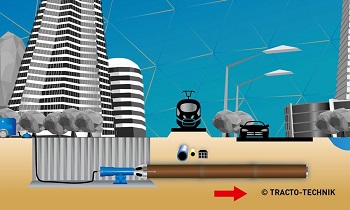 BADGER will perform autonomous excavation of small diameter, high gradient tunnels in urban environments. (Source: Tracto-Technik GMbH & Co. KG)transformation of very congested environments such as modern cities. The intelligent system-equipped robot will perform installations such as wiring or scoring without the need for trenches or traffic rerouting.
Implementation of such advanced robotics technologies with cognitive and control abilities has multiple applications. The researchers envision uses in landslide-associated search and rescue operations, mining activities, resource exploration and mapping.
Scientists from University of Glasgow School of Engineering (Scotland), the Centre for Research and Technology, Hellas (Greece), IDS Georadar S.r.l. (Italy), Singular Logic S.A. (Greece), Tracto-Technik GMbH & Co. KG (Germany) and Robotnik Automation SLL (Spain) are collaborating on this research.
