
The cost advantages of light-emitting diode (LED) technology are finally being reflected in the price of LED TVs. Prices for TVs featuring LED backlighting have declined by as much as 40 percent in the US during the past three years, according IHS, making them more cost-competitive with other TV offerings.
LED technology uses significantly less power than older technologies such as plasma, but a dearth of competition in the market has kept prices relatively high. But that’s beginning to change: The average retail price for LED TVs sold in the United States dropped to $1,251 in the fourth quarter of 2012, down 38 percent from $2,031 in the first quarter of 2010, according to the IHS TV Price and Specifications Tracker from the TV Systems Intelligence Service.
The drop narrows the average price gap between and LED TV and an LCD TV using conventional cold-cathode fluorescent lamp (CCFL) backlighting to just $620, down from $1,127 in the first quarter of 2010. The average LED TV pricing is now $364 lower than the average plasma display panel (PDP) TV. In the first quarter of 2010 it was $289 more expensive.
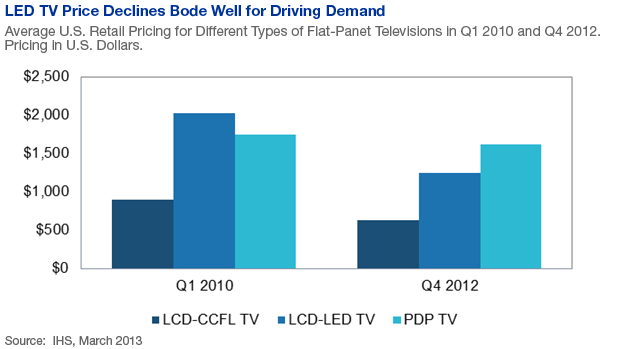
“LED TVs, with their thinner screens and lower power consumption, have become a more affordable alternative in recent years compared to older display and backlighting technologies,” said Veronica Thayer, TV systems analyst at IHS. “Prices have come down as more models have entered the market. Second- and third-tier television brands are offering more LED TVs, ratcheting up the competition and reducing prices. Television makers also are offering LED TVs with smaller displays, contributing to the overall decline in pricing.”
Meanwhile, plasma TV pricing has held steady, contracting by just 7.3 percent during the past three years.
Plasma TVs are being marketed as more exclusive, high-end products. Almost all plasma models now available have 3-D and Internet-connectivity features.
