

The rapid growth of AI data centers is creating a secondary market in the recycling of used and older parts as well as raw materials from these facilities.
This new recycling economy is taking GPUs, CPUs and memory as well as materials like copper and giving them second life in other machines or, at the very least, recycling them for future use.
AI data centers are refreshing GPUs and CPUs at a much faster rate than traditional IT hardware cycles. Some of these parts are being refreshed within three to four years but in some hyperscale AI deployments, even sooner. By comparison, traditional cloud and enterprise data centers operate on a longer timeline of about five to seven years.
What is driving this acceleration in hardware turnover?
“A perfect storm of performance demands, competitive pressure and rapid innovation is accelerating the rate at which GPUs and CPUs are cycled out of AI data centers,” said Linda Li, chief strategy officer at LTG/Re-Teck, a vendor specializing in reverse supply chain management (RSCM). “In hyperscale environments, even incremental efficiency improvements can translate into millions of dollars in savings, making the case for early hardware refresh hard to ignore.”
Combined with a competitive race to build and deploy ever-larger, more capable models, the incentive to adopt the latest and greatest hardware as soon as it is available has become even stronger, Li said.
Refresh rate acceleration
The data center market is forecast to reach $687.65 billion by 2032, more than doubling the revenue from the projected $283.16 billion in 2026, according to data from market research firm MarketsandMarkets.
This tremendous growth will impact multiple sectors inside electronic components like memory, GPU and power ICs but also other parts of the ecosystem like materials and construction. And as a result, companies will continually add the latest and greatest to maximize power and efficiency gains.
Unlike traditional IT infrastructure, AI hardware is directly tied to business outcomes like:
- Model training efficiency
- Inference speed
- Revenue
Each new generation of AI-optimized processes delivers meaningful gains in performance by watt, memory bandwidth and raw processing power. This, in turn, reduces training times and drives down the costs of operating.
“The most common driver is raw performance,” Li said. “Each new chip generation tends to deliver meaningful gains in compute density, memory bandwidth and interconnect speed, which translates directly into faster model training and lower costs.”
Li added in these competitive AI environments, even shaving just weeks off a training cycle is compelling enough to refresh hardware ahead of schedule.
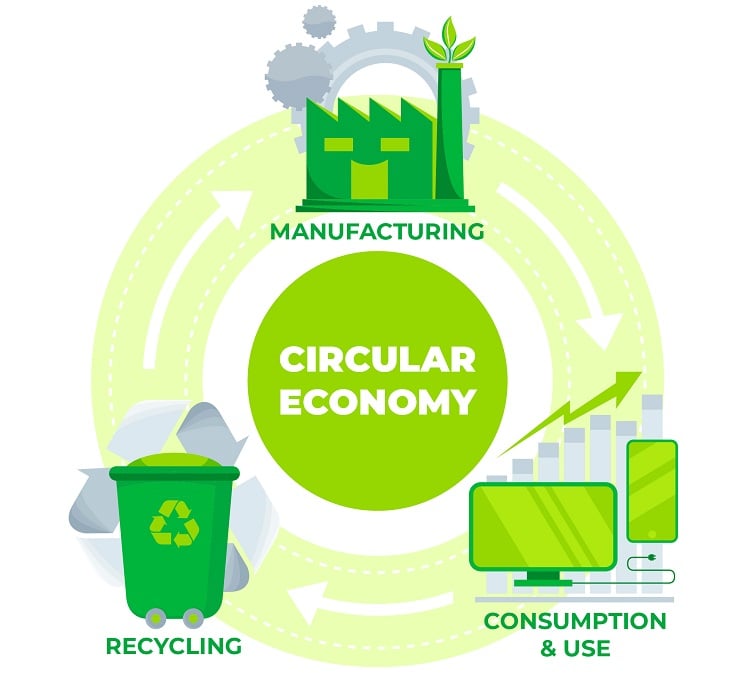 How data centers are creating a new recycling economy where retired data center GPUs and CPUs are finding second life in other applications. Source: Re-Teck
Second life chips
According to Re-Teck, a CPU or CPU retired from a frontline AI training cluster often has plenty of use left.
One of the most common second life pathways is inference workloads. This is where latency and throughput requirements are less demanding than large-scale model training.
Older AI GPUs can be recycled into high-performance computing PCs for scientific research and simulation. Li said that universities, research labs and enterprise data centers are natural recipients for this kind of recycled hardware.
However, these components often have restrictions imposed by the original manufacturers or governments that require rules
“Sometimes, rather than redeploying a system in its entirety, it makes more sense to harvest individual components that can find new homes in compatible systems,” Li said. “CPUs pulled from AI clusters are often a good fit for edge computing or private cloud environments where workload intensity is more modest.”
Li cautioned, however, that not all second-life deployments are straightforward because many of these GPUs and CPUs are built for specialized server architectures with specific cooling and power requirements. This limits their second life chances.
 Shredded e-waste that is being recycled into new materials. AI data centers have a lot of it and it is part of the growing new recycling economy emerging. Source: Re-Teck
Secondary copper opportunities
Copper is one of the most critical materials used for connectivity across data centers and other electronics.
As retrofits to data centers accelerate, decisions will be made to reuse or replace copper in these facilities. The value of copper scrap reduces the likelihood of it being thrown away.
“Much of the copper in data center infrastructure can be remelted and reused by secondary smelters, since it is already high-grade, best for conductivity,” said Adam Kotrba, flat products director for the Copper Development Association (CDA). “Recycled copper is and will become ever more important in data centers in the future.”
Kotrba said as data center owners and operators further prioritize sustainability, organizations like iMasons and the Open Compute Project, along with the data center community, are driving carbon accounting such as embodied carbon in data center equipment and materials like copper.
Additionally, new secondary copper refining facilities have opened in the U.S. recently to convert copper scrap into refined metal, according to the CDA. These facilities will help complement primary copper supplies and allow for more U.S.-generated scrap to be processed domestically instead of being exported.
Currently, about 50% of copper-bearing scrap is exported, according to the CDA.
“Since recycled copper has lower embodied carbon than primary sources, it is of high interest to data centers in support of their efforts to reduce embodied and operational carbon,” Kotrba said.
As a result, many hyperscalers are now committing to reducing operational carbon using renewable energies as their power source. Google has been using renewable energy as part of its sustainability approach for the past 10 years, Kotrba said.
Recycled demand
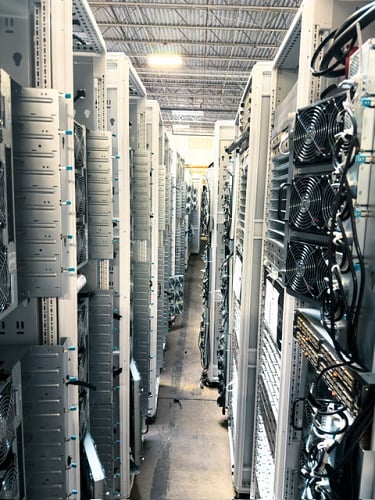 Recycled server racks are part of a growing recycled economy emerging from old or retired electronic components from AI data centers. These devices are finding new life in other applications. Source: Re-Teck According to Re-Teck, there is a growing demand for recycled data center components. Whether it be due to cost savings, supply constraints, sustainability commitments or practicality, demand for recycled goods is coming from multiple directions.
Li said part of the reason for demand is because the hardware “doesn’t need to compete with cutting edge silicon” as it just “needs to be good enough” for the intended workload at a lower price point.
Many edge deployments don’t require the latest generation of accelerators but need server-grade hardware to handle real workloads. And if it comes at a less than premium price tag, all more the better, Li said.
Other potential use cases for these recycled CPUs and GPUs include:
- Web hosting
- Storage clusters
- Batch processing equipment
- Education
“Budget-conscious enterprises, startups and research institutions also represent a strong market,” Li said. “Organizations that can't justify the cost or lead times of brand-new systems can put refurbished hardware to work for model experimentation, internal AI projects, or less compute-intensive training tasks.”
Conclusion
Turnover in GPUs and CPUs from AI data centers is expected to increase in the coming years as innovation cycles continue to compress, Re-Teck said.
First, the scale of AI infrastructure is expanding significantly as hyperscalers and enterprise vendors build larger, more demanding facilities. This naturally means more hardware recycling through refresh and end-of-life stages, Li said.
Secondly, innovation in semiconductors is not slowing. AI processors are only becoming more powerful. This will continue the financial incentive for operators to turnover GPUs and CPUs sooner rather than later.
As holding onto older equipment becomes harder to justify, turnover will only accelerate but not every workload will demand the latest and greatest.
“A natural stratification is likely to emerge: leading-edge AI environments will turn over quickly to stay competitive, while second-tier or more specialized deployments may extend asset life a bit longer,” Li added.
