Controllable stem cell microbots that can heal spinal injuries in animals have been developed by a team of researchers from ETH Zurich and the University of Zurich (UZH).
To develop biohybrid robots composed of neural progenitor cells (NPCs) in combination with magnetoelectric nanoparticles, the team used lab-on-a-chip (LoC) technology. Tthe nanoparticles feature two layers with separate functions. The inner layer responds to magnetic fields to control direction while the outer layer converts that response into electrical signals that encourage cell growth.
 Source: ETH Zurich
“We place a reservoir in the center where we trap the cells,” the team explained. “Then we inject the nanoparticles and wait for the two components to bind.”
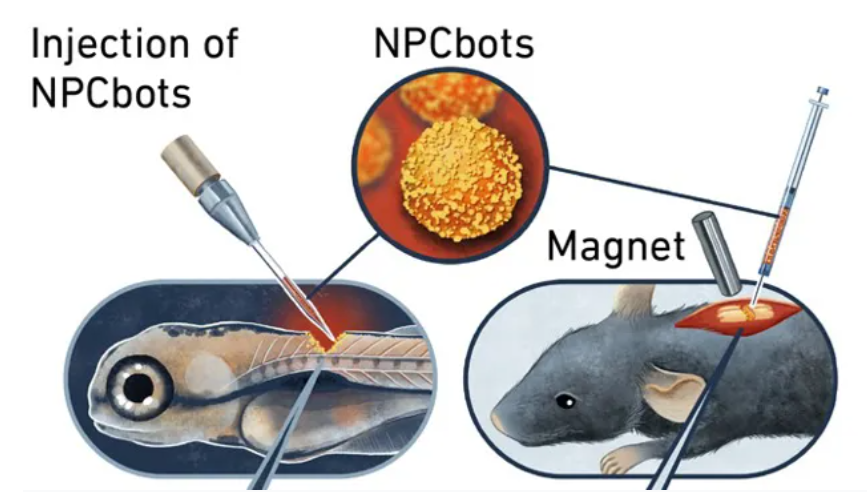
The NPCbots take roughly 30 minutes to create using the LoC technology and they measure roughly 6 micrometers in size. Once developed, the robots can be injected into living organisms and then magnetically guided to an injury site, where they encourage the growth of new nerve cells.
The NPCbots were trialed in the lab on zebrafish larvae with spinal cord injuries. The NPCbots were injected into the site of the injury, after which electromagnetic fields were used to guide them and encourage repair. After three days, the zebrafish demonstrated almost normal swimming and exploratory behavior.
The NPCbots were also trialed on mice with severed spinal cords. Following almost 28 days, the nerve cells in mice reconnected at the injury site. The mice exhibited ‘increasingly normal movement patterns’ during the recovery period. Importantly, unlike zebrafish, the spinal cords of mice do not typically regenerate.
Its developers suggest that the NPCbots could have applications in cardiology, oncology, wound healing and other targeted regenerative therapies.
The NPCbots are detailed in an article, “Magnetoelectric microrobots for spinal cord injury regeneration,” which appears in the journal Nature Materials.
