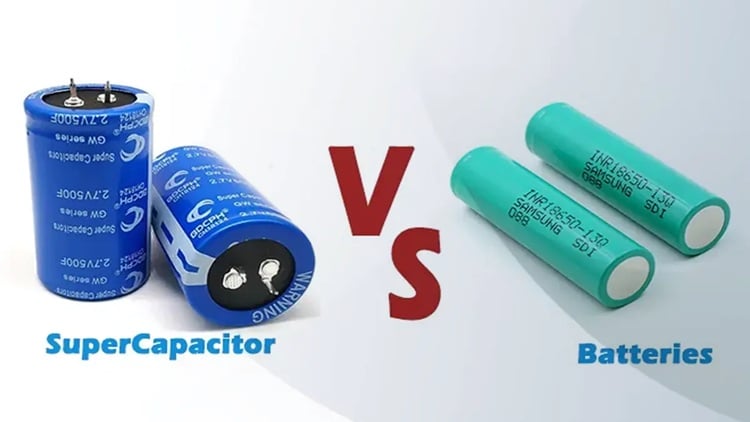
Two common types of energy storage devices are rechargeable batteries and supercapacitors, with the benefits of one kind usually outweighing the drawbacks of the other. Overcoming the constraints of conventional capacitors and batteries, supercapacitors use a combination of surface-based capacitance and diffusion-controlled electrode materials, like metal oxides, sulfides or metal-organic frameworks (MOFs).
Superior energy storage capacity is a hallmark of batteries, while increased power rates and longer cycle life are hallmarks of supercapacitors. Since they can handle rapid, high-current charge/discharge cycles, supercapacitors are ideal for absorbing peak loads and reducing stress on primary battery systems, even though they do not have the energy density of batteries. This article explores many uses for supercapacitors as an alternative to batteries.
Transportation and electric vehicles
Electric vehicles necessitate sudden surges of power while starting, accelerating or driving uphill. Instead of using an excessively large battery pack, supercapacitors can manage these brief bursts of high power, relieving stress on the main battery. The reduced strain on the battery also makes it possible to use smaller packs of batteries. In Europe and China, for instance, hybrid buses and trams rely on supercapacitors for regenerative braking power; these vehicles may typically be recharged in as little as 15 to 30 seconds at a station.
Supercapacitors are able to manage the frequent, high-current engine restarts in vehicles equipped with autonomous start-stop technology. As a result, the lead-acid battery is shielded from damage, its lifespan is increased or a backup battery can be used instead. In addition, they let electric vehicles, buses and trains accelerate quickly, freeing up the primary battery to focus on range optimization rather than power.
Renewable energy and smart grids
Due to the intermittent nature of renewable energy sources like solar and wind, supercapacitors alleviate the strain of high-frequency cycling on battery systems by acting as buffers to absorb power spikes and fill in brief power drops. Additionally, they level out microgrid voltage fluctuations, which makes conventional batteries better for long-term storage. Reducing the overall levelized cost of energy (LCOE) and installation costs by 10% to 15% is possible with hybrid systems that use supercapacitors instead of batteries alone.
Industrial automation and machinery
Power spikes lasting only a few seconds are common for industrial machinery like cranes, robotic arms and welding equipment. These powerful, short-lived "spike" loads can be handled by supercapacitors, which means the main battery does not have to. Because it is solely built for average load and not peak load, the battery pack can be smaller and more efficient. Similarly, forklifts, automated guided vehicles (AGVs) and material handling devices all produce energy when they lower or brake a load. Regenerative braking's frequent, high-current cycles are taxing on batteries, but supercapacitors can store this quickly, making them perfect for brief bursts of high-power braking.
Portable and consumer electronics
The data transmitted by internet of things (IoT) devices, such as sensors or smart meters, can be harmful to lithium-ion batteries due to the high-current pulses and short-duration activities they produce, similar to global system for mobile communications (GSM) transmission. To protect the battery from these sudden surges of power and prolong its life, a supercapacitor is a good choice.
As a "buffer" that charges rapidly from small, irregular energy inputs and releases the charged energy in bursts, the supercapacitor is used in energy-harvesting IoT applications (such as powering a sensor with solar panels). Because of this, big batteries that are not efficient when charged with little energy are unnecessary. Some gadgets, like e-bike lights or flash units, can even charge quickly enough to replace batteries, or they can provide short-term power and allow for rapid recharge in seconds.
Short-term backup power
Supercapacitors eliminate the need for huge, high-maintenance battery banks due to their high-power output, which bridges the gap (10+ seconds) until generators start. Users will not have to worry about replacing or maintaining supercapacitors as often as batteries because they can withstand thousands of charge/discharge cycles without deteriorating. Batteries can be made smaller and more efficient by combining them with supercapacitors, which can manage high peak power demands and fast swings. Their recharging period is comparable to their use duration; therefore, they can restore system reliability nearly instantly following a power outage.
Emerging technologies (2026 trends)
New "supercapatteries" energy storage devices combine the energy density of batteries with the power of capacitors, offering a middle ground that can power small electronics for extended periods while recharging in minutes. Ultra-thin, flexible graphene supercapacitors are enabling battery-less medical implants (like pacemakers and sensors) and wearable tech that can be integrated directly into clothing or even biological tissue. Supercapacitors are being integrated directly into vehicle wiring harnesses and body panels to save weight and space that would otherwise be occupied by traditional battery enclosures.
Conclusion
In conclusion, supercapacitors can greatly minimize the requirement for batteries in many applications, notably by working as complementary, high-power and long-lifespan storage devices. They thrive in settings demanding rapid energy bursts and regular cycling, allowing them to take over the peak power load that produces, heat, stress and premature degradation in standard batteries.
