
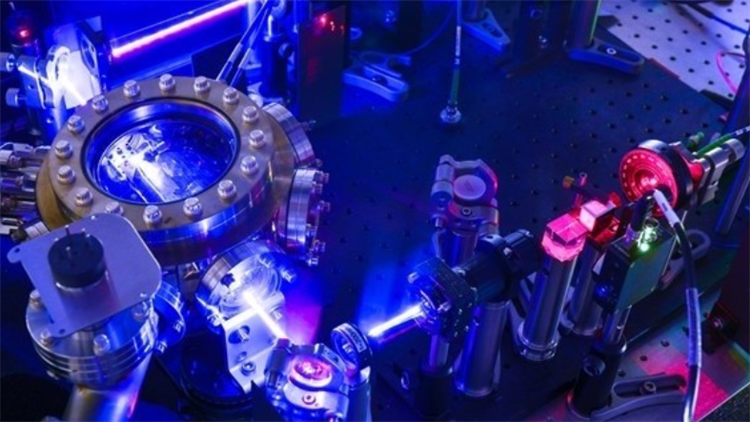
For over a century, the fundamental recipe for a radio antenna hasn’t changed much. However, researchers have recently been working on a type of receiver that does away with metal entirely, replacing copper wires with a glass tube full of giant, laser-excited atoms. These systems, known as Rydberg antennas or receivers, could be the future of electronic communications, especially in areas where there is active jamming. But there are still some hurdles to overcome before they’re ready for prime time.
RF levels up
To detect radio signals using a gas, researchers first have to perform a quantum magic trick. They use a sequence of lasers to inflate a tiny atom — typically a cesium atom — into a giant version of itself, with its electrons in a high energy state. By comparison, this is like sizing up from a marble to a beach ball.
Atoms in these excited states are called Rydberg atoms, after the 19th century Swedish physicist Johannes Rydberg, who came up with the mathematical formula to predict the energy levels of atoms.
Translating this bloated quantum state into a receiver for radio signal requires some fancy work with lasers. Typically, if one were to shine a specific color of red laser, say at 852 nm wavelength, into a tube of gas, the atoms will block it, not allowing any light to reach a photodetector on the other side. However, using a technique called electromagnetically induced transparency, researchers can use a second laser at a different frequency — for example, green light at 509 nm — as a coupling laser. When the two lasers hit the atoms at the exact right frequencies, they create a phenomenon called quantum interference.
In this case, the interference cancels out the atom’s absorption of the light, allowing the probe light to pass straight through to the photodetector on the other side. However, this interference state is extremely fragile. Any radio signal that hits that atom throws it out of balance, causing an effect known as Autler-Townes splitting, where the energy levels of the atom split.
This causes the atoms to lose its transparency and absorb some of the probe laser light. The more atoms that are affected by this splitting, the less light gets through to the photodetector on the other side. An algorithm can then translate those light flickers into binary code to decode the radio signal that caused the instability.
The advantages of atoms
This innovation has four distinct advantages over traditional antennas.
First, it can capture signals over a huge range of frequencies without needing a change in hardware. Metal antennas have to be cut to a specific size and angle to match a specific frequency. Atoms can listen to a massive range of frequencies, from normal radio all the way up to sub-terahertz, simply by changing the frequency of its lasers or using different atomic energy levels.
A recent paper showed how a receiver can hop between 3 GHz and 15 GHz almost instantly, showcasing a feature that metal antennas simply can’t match. This frequency hopping spread spectrum (FHSS) technique is a key aspect of secure military communication systems, and Rydberg antennas can do it orders of magnitude better than a traditional metal antenna. They have a theoretical ability to support up to 150,000 discrete channels, compared to the 79 available on the Bluetooth standard.
Metal antennas are also susceptible to detection, which is less than ideal in a hostile environment. They act like a mirror to radar systems, figuratively painting a giant cross hair on anything using a large enough antenna, and making it much easier for adversaries to pinpoint locations of those deployed systems. Gas and glass, on the other hand, are essentially invisible to radar, making them particularly useful when trying to hide the receiver from hostile actors, and especially useful if they manage to shrink them down to the point where they can be embedded on a stealth fighter or ship.
They can also recover quickly from massive “burst” electromagnetic weapons, such as EMPs, that might permanently disable metal-based antennas. A Rydberg antenna could simply reset the lasers and keep operating.
The atoms in the glass tubes are so sensitive to even the slightest electromagnetic fields that they can pick up weak signals that normal metal antennas might miss. They also don’t require any change in resistance for their measurement. Also, they don’t suffer from thermal noise that adds a baseline noise threshold to most metal antennas from the random jiggling of electrons that create heat.
Finally, the electronics that go along with metal antennas must be fine-tuned to the specific frequency that they are attempting to monitor. In modern systems, this is typically done with a software defined radio (SDR) algorithm. But since the measurements of Rydberg antennas are based on the fundamental constants of the universe, such as Planck’s constant, there is no need to calibrate them and they don’t drift over time.
Not yet ready for primetime
That is not to say that Rydberg antennas are ready for prime-time deployment yet. They also have their disadvantages, which can be broken down into three categories: complexity, bandwidth and error rate.
A Rydberg antenna is complex to say the least. It requires multiple sets of lasers, precise optical equipment such as mirrors and lenses, a glass vapor cell and an advanced photodetector with its associated algorithm.
All of that is not easy to shrink down into the size of a cell phone. So far, most setups have only operated in the lab, though there are companies working on actively commercializing both the sub-components necessary for these systems, as well as complete systems themselves.
But even if there were a complete commercial system ready to go, they still would face bandwidth limitations. Traditional antennas can handle very wide streams of data all at once, whereas the atoms of a Rydberg antenna require a bit of time to react and settle down every time they are hit with an electromagnetic wave. This limits the bandwidth of these antennas to around 700 kHz, which is nowhere near the bandwidth needed for modern day applications, like the internet. It might be good enough for specialized military uses in otherwise inaccessible areas, though.
The antennas suffer from a related problem at higher speeds, where their error rate starts to climb. The recent paper that described an antenna’s ability to switch between frequencies 20,000 times a second also had a 9% error rate when trying to transmit data at 1 Mbps, and the error rate notably increased the faster the transmission was. While those errors were corrected enough to make the QR code readable, that high of an error rate requires significant processing to adjust properly.
A Quantum leap for communication
Despite these challenges, the potential benefits of Rydberg antennas provide enough promise to warrant continued development of this seemingly magical quantum antenna. It might be a few decades before they are deployed even in the relatively niche domains of military and space missions, and, depending on their eventual bandwidth limitations, they might never be deployed for everyday commercial use.
But the idea of a highly sensitive radio antenna that uses nothing but the quantum state of atoms and some lasers surely sounds like something straight out of science fiction, even if it is poised to augur a change from the traditional antenna for the first time in 100 years.
