
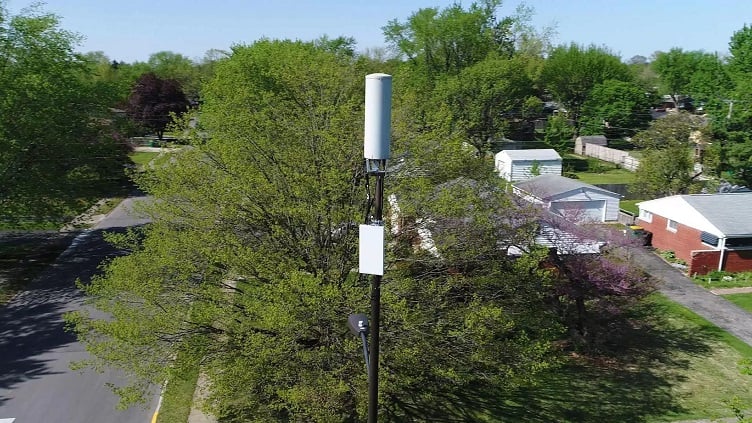
5G millimeter wave (mmWave) has long held the promise to allow carriers to offer higher data speeds, lower latency and faster speeds compared to traditional 5G technology.
The issue has always been that these high frequencies — roughly 24 GHz to 100 GHz spectrum — don’t travel that far and have trouble penetrating through objects like trees, buildings, walls and even rain.
In short, 5G ultra-fast speeds are possible with mmWave, but only if close to an antenna. As a result, current 5G mmWave deployments have been limited to dense urban areas, stadiums, airports and hotspots.
How does the industry get widespread deployment of mmWave? It might take 6G.
According to T-Mobile, mmWave remains part of the ecosystem today as part of the company’s broader 5G strategy focused on mid-band spectrum.
“Over time, advances in RAN intelligence and new spectrum availability will enable more flexible use of all frequency bands, including mmWave and beyond, as part of the evolution toward 6G,” a T-Mobile spokesperson said.
A privileged bridge
Ongoing 3rd Generation Partnership Project (3GPP) standard releases continue to strengthen the foundations for broader mmWave deployments. But it looks like scaling the deployment of mmWave will happen as a privileged bridge between 5G and 6G and then as fully part of the 6G deployment.
And solutions are ready to go when telecoms pull the switch, according to Luis Andia, business development director for the Mobile Communications Division at Soitec. Soitec develops substrates used to build chips that enable next generation mmWave semiconductors.
“The convergence of technologies and applications lies at the heart of mmWave adoption, which will continue to accelerate as emerging use cases demand ultra-low latency and high RF performance,” Andia said.
Enhancing mmWave commercial appeal is what many companies are focusing on to deliver the right solutions at the right cost, Andia said. This includes use cases like:
- Extended reality
- Integrated precision sensing
- Connected mobility
- High-precision industrial control networks
- Microclouds
Paths to scalability
To scale mmWave, there are several potential paths.
Currently, deployments are accomplished through densification of small cell deployments in malls, stadiums or dense urban areas and neighborhoods.
Future deployments may include massive multiple-input and multiple-output (MIMO) and beamforming to transmit and receive multi data streams and focus signals on specific users or focal points, Andia said.
Dynamic switching between mmWave and sub-6 GHz bands for seamless coverage is something already being developed and will likely be expanded as the technology matures.
Fixed wireless access (FWA), otherwise known as cellular broadband, is also a way to extend mmWave range by combining fixed high-sensitivity receivers with existing telecom networks. Repeaters and relays are then used to reach around obstacles, Andia said.
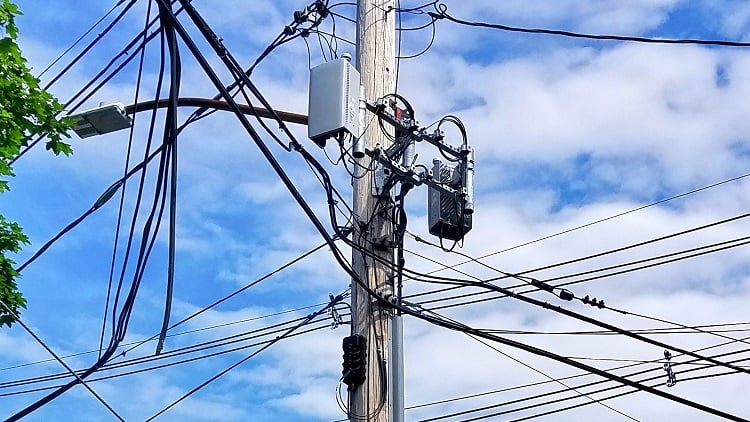 A utility pole with Verizon 5G mmWave antennas in Arlington, Massachusetts. Deployments such as these may expand with the implementation of 6G and SATCOM. Source: Daderot/CC0
SATCOM and mmWave
Another possible path to scaling mmWave is through the development of satellite communication (SATCOM), a growing next-generation communications technology using satellites for cellular connectivity.
“[mmWave has a] tremendous amount of loss in signal,” said Shankaran Janardhanan, senior VP of radio frequency (RF) business at pure-play foundry GlobalFoundries. “The biggest issues are solving the line-of-sight issues and frequency loss when it can’t penetrate through walls or buildings.”
Janardhanan said SATCOM is a natural evolution of mmWave because it doesn’t need high fidelity cell towers or to be bent around buildings, trees or other obstacles since the signals are coming from space.
“SATCOM is a better use case for mmWave,” he said. “SATCOM is establishing direct-to-cell networks. As the industry puts more satellites in space, that infrastructure will grow and services will grow.”
As 6G rolls out, a combination of 6G cellular infrastructure with SATCOM augmenting it will likely lead to higher deployments of mmWave as the two technologies coexist and increase the bandwidth capacity for data tremendously, Janardhanan said.
New materials
Enhancing these solutions will require a diverse range of semiconductor technologies.
mmWave RF solutions must be compact but also power efficient and robust. Materials like fully depleted silicon-on-insulator (FD-SOI) are already used in cellular transceivers and frequency converters.
RF-SOI solutions will complement current FD-SOI technology for mmWave. Soitec has developed a mmWave substrate, called mmWESI, that is a variant of trap-rich high resistivity RF-SOI (RFeSI) which is designed for performance up to sub-THz frequencies. The technology is currently being integrated into RF-SOI foundry platforms, Andia said.
This material will allow for RFIC design density for compact RF front ends that integrate mmWave and sub-6 GHz modules. This along with emerging AI accelerators and processors will be one potential solution for scalable deployments of mmWave between the 5G and 6G eras.
