
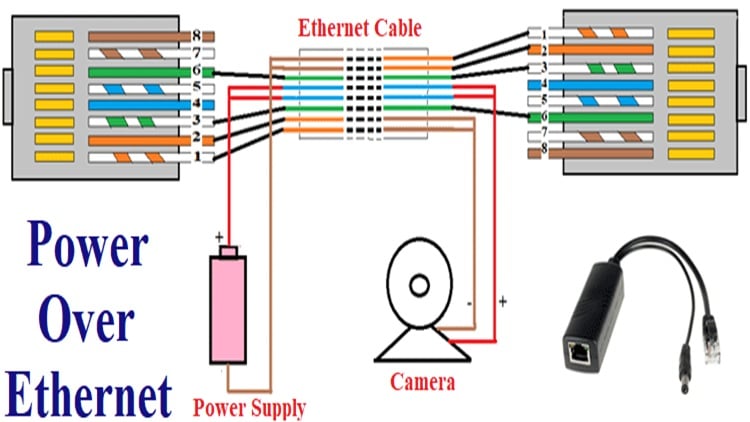
Power over Ethernet (PoE) systems are technologies that deliver both electrical power and data over a single Ethernet cable, typically a twisted-pair cable like Cat5e or Cat6. A twisted-pair cable, such as Cat5e or Cat6, is a type of wiring used for networking and telecommunications, where pairs of copper wires are twisted together to transmit data and, in some cases, power. They allow networked devices to operate without requiring a separate power source, streamlining installation and reducing infrastructure costs. In 2025, with the rapid adoption of internet of things (IoT), 5G infrastructure and smart technologies, PoE is critical for enabling efficient, scalable and cost-effective network deployments across industries like healthcare, education and enterprise IT.
Key components
- PoE injector or switch: A device that adds power to the Ethernet cable. A PoE switch provides multiple PoE-enabled ports, while an injector powers a single device.
- Powered device (PD): The device receiving power and data, such as IP cameras, VoIP phones, wireless access points or IoT sensors.
- Ethernet cable: Carries both data and power. The power is transmitted over unused wire pairs (in older standards) or alongside data on the same pairs (in newer standards).
- PoE standards: Defined by the Institute of Electrical and Electronics Engineers (IEEE), common standards include:
- 802.3af (PoE): Up to 15.4 W of power (12.95 W at the device).
- 802.3at (PoE+): Up to 30 W (25.5 W at the device).
- 802.3bt (PoE++): Up to 60 W or 90 W, supporting high-power devices like 4K cameras or LED lighting.
Operating process
- The PoE switch or injector detects a compatible PD and negotiates the required power level.
- Power is sent over the Ethernet cable alongside data, using techniques like phantom power (power sent over data pairs) or spare pair power delivery.
- The PD uses the power for operation while simultaneously communicating data over the network.
The utility of PoE
- Simplified installation: PoE delivers both power and data over a single Ethernet cable, eliminating the need for separate power lines. This reduces installation complexity and costs, especially for devices like IP cameras, VoIP phones and wireless access points.
- Cost efficiency: By removing the need for additional electrical wiring and outlets, PoE lowers infrastructure expenses, particularly in large-scale deployments like smart buildings or enterprise networks.
- Flexibility and scalability: PoE allows devices to be installed in locations without nearby power outlets, such as ceilings or outdoor areas, making it easier to expand networks. This is critical for IoT devices, smart lighting and security systems.
- Energy efficiency: Modern PoE standards (e.g., IEEE 802.3at/af/bt) support efficient power management, delivering only the power needed by devices. This aligns with the push for greener, energy-conscious technologies.
- Rising demand for IoT and smart systems: The growth of IoT, smart homes and smart cities relies on powering numerous connected devices. PoE supports this by providing a reliable, standardized way to power and connect sensors, cameras and other devices.
- Safety and reliability: PoE systems operate at low voltages, reducing electrical hazards. They also support centralized power management, ensuring uptime during outages with backup power systems like UPS.
- Support for high-power applications: Newer PoE standards (e.g., 802.3bt) deliver up to 90 W per port, enabling high-power devices like 4K cameras, LED lighting and even laptops, expanding PoE’s use cases.
PoE standards
IEEE defines PoE standards, each supporting different power levels and applications:
- IEEE 802.3af (PoE):
- Power output: Up to 15.4 W at the PSE, 12.95 W at the PD (after cable losses).
- Use cases: Basic devices like VoIP phones, simple IP cameras and early wireless access points.
- Uses two pairs of twisted-pair cables.
- IEEE 802.3at (PoE+):
- Power output: Up to 30 W at the PSE, 25.5 W at the PD.
- Use cases: Advanced IP cameras (e.g., pan-tilt-zoom), dual-band Wi-Fi access points and small LED lighting systems.
- Also uses two pairs but with higher current capacity.
- IEEE 802.3bt (PoE++, Type 3 and Type 4):
- Type 3: Up to 60 W at the PSE, ~51 W at the PD.
- Type 4: Up to 90 W at the PSE, ~71 W at the PD.
- Use cases: High-power devices like 4K cameras, smart building systems, PoE-powered laptops and advanced IoT devices.
- Uses all four pairs for power and data, supporting 10 Gbps Ethernet (e.g., Cat6a or Cat7).
- Proprietary PoE: Some manufacturers offer non-standard PoE solutions (e.g., Cisco’s UPoE), but these may not be interoperable with IEEE-compliant devices.
Applications
PoE is widely adopted across industries due to its versatility. Key applications include:
- Surveillance: Powers IP cameras, enabling flexible placement in areas without power outlets (e.g., parking lots, ceilings).
- Networking: Supports wireless access points, routers and switches, critical for enterprise and campus Wi-Fi networks.
- Telecommunications: Powers VoIP phones, reducing desk clutter and simplifying office setups.
- Smart buildings: Enables smart lighting, HVAC controls and sensors for energy-efficient building management.
- IoT: Powers sensors, smart locks and environmental monitors in smart homes and cities.
- Retail and healthcare: Supports point-of-sale systems, digital signage and medical devices like patient monitors.
- Emerging uses: With 802.3bt, PoE now powers devices like thin clients, small displays and even laptops, expanding its role in enterprise IT.
Conclusion
PoE is a critical technology that delivers both power and data over a single Ethernet cable, simplifying installations and reducing costs. It supports a wide range of devices, from IP cameras to IoT sensors, with evolving standards like 802.3bt enabling high-power applications up to 90 W. PoE enhances flexibility, scalability and energy efficiency, making it vital for smart buildings, IoT and modern networks. Its low-voltage operation ensures safety, while centralized power management boosts reliability. As of 2025, PoE’s role in 5G, Wi-Fi 6 and sustainable infrastructure continues to grow, driving widespread adoption.

