
Industrial Electronics

Active thermography in NDT — Advantages, challenges, opportunities

15 September 2025

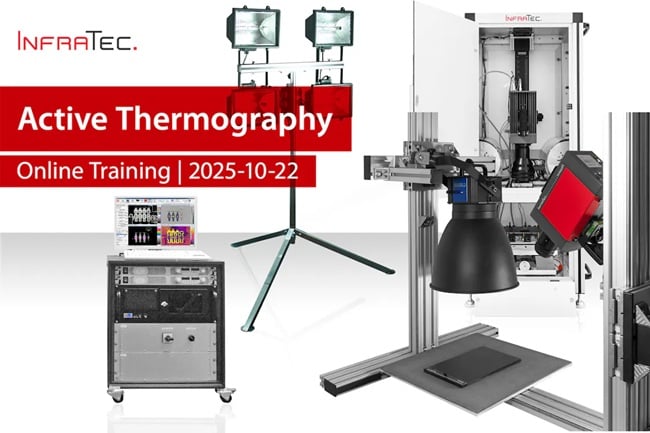
Active thermography in combination with high-resolution infrared cameras is an elegant testing method to analyze measuring objects in a non-contact and non-destructive testing (NDT) manner. As an optical measurement method, it enables fast defect detection and quality assurance — nearly regardless of the object material.
Active thermography is suitable for anyone who is faced with a specific testing challenge and is, for example, developing a prototype or is already on the verge of serial production. This testing method provides insights into the future viability of a product or material and it is also a reliable method in the area of quality assurance.
Source: InfraTec GmbHSource: InfraTec GmbH

How does active thermography work?

This non-contact testing method enables the analysis of both small- as well as large-area objects made from a wide variety of materials and for most different types of failures. The object to be inspected is energetically excited, which generates heat within the object. This leads to a pattern of temperature differences on the surface of the object, which is detected with highly sensitive infrared cameras. The analysis of these patterns enables conclusions to be drawn about the material properties and the condition of the test object. The big advantage: the test object remains intact and can be used for further tests or improved if necessary.

Participants in the online training "Active Thermography in NDT — Advantages, Challenges, Opportunities" by InfraTec will learn everything required to get started efficiently with active thermography. The seminar explains which methods are best suited for which inspection tasks. Supplementary practical exercises also illustrate the variety of possible applications and give an impression of the numerous possibilities of active thermography.

Register for this seminar, scheduled for October 22, 2025, 9:00 AM to 4:00 PM (CEST). The registration deadline is October 1, 2025.

To contact the author of this article, email GlobalSpecEditors@globalspec.com


Powered by CR4, the Engineering Community

Discussion – 0 comments

By posting a comment you confirm that you have read and accept our Posting Rules and Terms of Use.
Engineering Newsletter Signup
Get the GlobalSpec
Stay up to date on:
Features the top stories, latest news, charts, insights and more on the end-to-end electronics value chain.
Advertisement
Weekly Newsletter
Get news, research, and analysis
on the Electronics industry in your
inbox every week - for FREE
Sign up for our FREE eNewsletter
Advertisement