
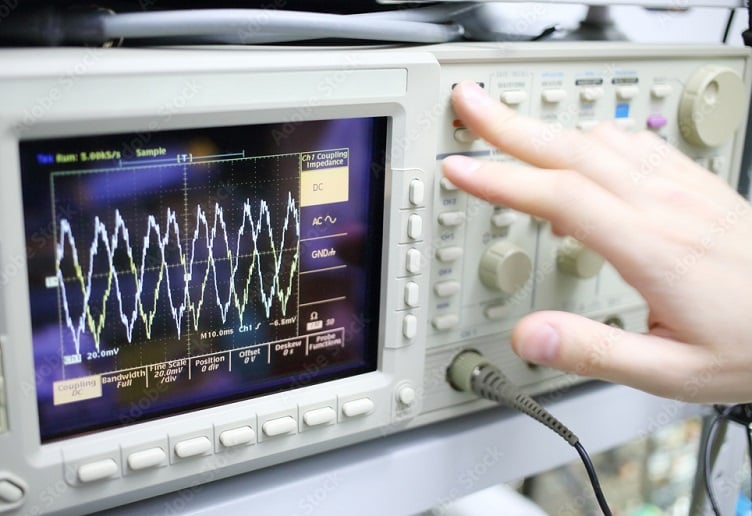
6G-ready oscilloscopes with bandwidths exceeding 100 GHz are critical for next-generation wireless communication research, particularly for 6G networks targeting data rates from 100 Gbps to 1 Tbps in the sub-terahertz (sub-THz) spectrum (e.g., 310 GHz).
These instruments must handle ultra-high-frequency signals, fast rise times and complex modulation schemes like QPSK at 80–160 GBaud, as seen in advanced R&D applications such as Nokia Bell Labs’ VDSL carriers.
Features and capabilities
High bandwidth: Oscilloscopes like the LeCroy WaveExpert 9000 and SDA 100G, introduced in 2007, offer 100 GHz bandwidth with coherent interleaved sampling for capturing long serial data waveforms without external triggers. Modern equivalents from Keysight and Tektronix push similar boundaries, with bandwidths up to 110 GHz for real-time signal analysis.
Sampling techniques: Coherent interleaved sampling and random interleaved sampling (RIS) enable precise tracking of high-bit-rate signals and pulsed measurements. These techniques, paired with high sampling rates (e.g., 10 Msamples/s), ensure accurate waveform reconstruction.
Applications: Essential for 6G R&D, including:
- Sub-THz signal analysis (e.g., 310 GHz with 30 GHz bandwidth).
- High-speed serial bus testing (PCIe 6.0, Fibre Channel, FB-DIMM).
- Time domain reflectometry (TDR) with 20-ps rise times for signal integrity.
- MIMO characterization and eye pattern/jitter analysis for compliance testing.
Challenges and considerations
Cost and complexity: Scopes with 100+ GHz bandwidth, like Keysight’s Infiniium series or LeCroy’s 100 GHz models, are expensive (often $1M+). Their complexity requires advanced expertise and specialized probes (e.g., differential probes for high-speed signals).
Signal integrity: Achieving low noise floors and high effective number of bits (ENOB) is critical to avoid distortion in sub-THz measurements.
Alternative tools: For some applications, real-time spectrum analyzers or down-converters paired with lower-bandwidth scopes may suffice, reducing costs but potentially sacrificing precision.
Practical considerations for electronics
Wide bandwidth is essential to accurately capture high-frequency transitions and harmonics. Probes must match or exceed the oscilloscope’s bandwidth, while de-embedding is required to correct for losses in cables and connectors.
Real-time sampling rates of 1–2 TS/s are typically needed to reconstruct 6G waveforms, but the ENOB of analog-to-digital converters decreases at these frequencies, demanding careful consideration of oversampling or averaging techniques. Maintaining signal integrity is crucial, with low jitter, high-quality coaxial connectors and low-loss interconnects being necessary.
6G-ready oscilloscopes often integrate advanced signal analysis tools such as vector signal analysis (VSA) for evaluating modulation quality, error vector magnitude (EVM) and constellation diagrams. Multi-channel synchronization is critical for MIMO and beamforming systems, while high-speed data handling and real-time processing are required due to massive data volumes.
Thermal management, software upgradability for evolving 6G standards, and cost-effective test environments with EMI shielding are also important considerations. These factors collectively ensure precise and reliable characterization of next-generation wireless technologies.
Current market
LeCroy (Teledyne): WaveExpert 9000 and SDA 100G remain benchmarks for 100 GHz performance, with advanced TDR and jitter analysis packages.
Keysight: Infiniium series offers 110 GHz bandwidth, low noise and compliance software for PCIe, USB and Ethernet (400G/800G).
Tektronix: The 6 Series B MSO, while typically lower bandwidth (up to 10 GHz), supports high-speed digital interfaces with compliance testing for Ethernet and USB, but lacks native 100 GHz capability.
Model recommendations
1) Teledyne LeCroy LabMaster 10 Zi-A (100 GHz)
Why: Offers 100 GHz bandwidth using digital bandwidth interleaving (DBI), with 240 GS/s sampling and up to 8 Gpts of acquisition memory. It’s well-suited for 6G R&D, high-speed serial data (56 to 112 Gbps) and applications like electronic warfare and optical signal research. Its CrossSync PHY software integrates protocol analysis for deeper insights.
- Applications: Sub-THz 6G testing, serial data jitter analysis, TDR for signal integrity and laser research.
- Pros: High memory depth for long waveform captures, 12-bit resolution and strong protocol analysis tools.
- Cons: Limited to one 100 GHz channel (four at 36 GHz), complex DBI setup may require expertise.
2) Teledyne LeCroy WaveMaster 8000 HD (up to 65 GHz)
Why: While not 100 GHz, this series offers up to 65 GHz bandwidth with 12-bit resolution and 8 Gpts memory, making it versatile for electronics applications like high-speed embedded systems, PCIe 6.0 and DDR testing. Its long memory and high sample rate capture both millisecond trends and picosecond glitches, ideal for debugging complex electronics.
- Applications: High-speed digital electronics, RF signal analysis and compliance testing for USB, DDR and Ethernet.
- Pros: Balances cost and performance, supports multi-instrument integration (e.g., protocol analyzers), and has a user-friendly interface.
- Cons: Lower bandwidth than 100 GHz models, less suited for sub-THz 6G applications.
Conclusion
As 6G standards are still evolving, oscilloscopes must be software-upgradable to accommodate new modulation schemes and compliance requirements. Artificial intelligence and machine learning algorithms are also becoming important for automating analysis and anomaly detection. Finally, cost and laboratory setup are major considerations.
High-performance 6G-ready oscilloscopes and their compatible probes, calibration kits and accessories represent a significant investment. Testing is often conducted in low-noise, electromagnetically shielded environments with precision fixtures to ensure repeatable and reliable results.
