
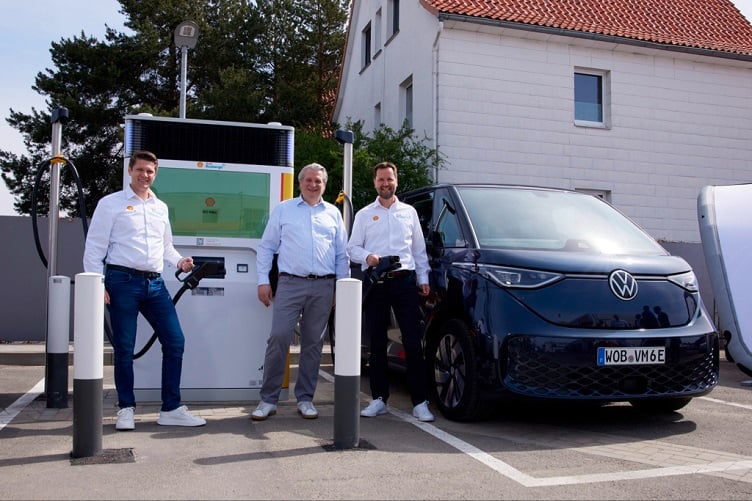
Oil and energy giant Shell plans to install more than 500,000 charging points by 2025 and 2.5 million by 2030 to help meet the demand of electrification in the automotive industry. Part of this is developing new ways to charge electric vehicles (EVs) fast and roll out infrastructure quickly.
Enter Shell’s collaboration with Volkswagen on the 150 kW Elli Flexpole charging stations.
The charging station of the Volkswagen brand Elli is a battery storage system that enables connection to a low-voltage grid and the stations can be installed easily, allowing for grid expansion to be accelerated. VW and Shell Germany installed the first Elli Flexpole and was put in operation at Shell’s Göttingen service station this month.
"With VW's Elli Flexpole charging stations, we can make an important contribution to the necessary expansion of the charging infrastructure,” said Tobias Bahnsen, head of Shell e-mobility in Germany, Austria and Switzerland. “And in locations where it would be otherwise difficult for fast charging.”
VW said the rapid expansion of charging infrastructure is critical for a successful transition to EVs by the automotive industry. The advantage of the Elli Flexpole is the infrastructure can be set up anywhere without major construction work.
Expanding infrastructure
According to the German Federal Network Agency, the German government wants at least one million charging points available in the country by 2030. The number of charging points rose to more than 80,000 last year with about 67,000 of these standard charging points and 13,000 fast charging points.
However, due to the need for special transformers for most EV chargers, the expansion of charging infrastructure is delayed in Germany.
Elli Flexpole chargers solve this issue by being connected directly to the low-voltage grid due to its integrated battery system. This eliminates the need for special transformers and construction work. The installation is significantly reduced and enables a charging speed of up to 150 kW, meaning an EV could be charged within 10 minutes.
