
Due to a challenging economic climate, the market for augmented and virtual reality (AR/VR) headsets is expected to grow slower than expected this year, according to new research from International Data Corp (IDC).
Shipments are expected to grow 14% in 2023 to 10/1 million units, however, the compound annual growth rate (CAGR) for the technology over the next five years is expected to be 32.6%.
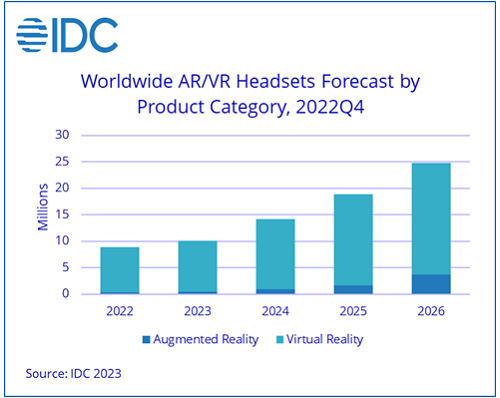 Source: IDC "Sony's new PSVR2 and Apple's foray into the space will help drive additional volume while new devices from Meta and Pico, expected towards the end of 2023, will build momentum for VR in 2024,” said Jitesh Ubrani, research manager for mobility and consumer devices at IDC. “Meanwhile, on the AR front, consumer-facing brands such as Xiaomi, Oppo, and TCL are all expected to drive consumer awareness for the category over the course of the next 6-18 months."
Another reason for the slower growth is due to the fast uptick in unit shipments in 2020 and 2021 during the COVID-19 pandemic lockdowns. This will lead to standalone VR headsets facing challenges in 2023, IDC said.
However, tethered VR as well as tethered AR glasses headsets will face an easier path for growth due to the dearth of volumes in 2022.
The AR segment has been popular with training and field service applications but with new form factors, brighter displays, crisp sound and a growing list of titles, consumer interest is expanding in the AR field, IDC said.
The complete research can be found in IDC’s “Worldwide Quarterly Augmented and Virtual Reality Headset Tracker” report.
