
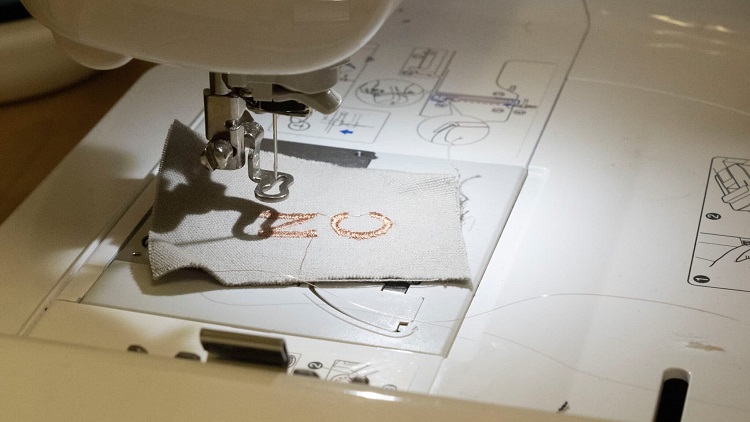
A new approach to developing power-generating smart fabrics to advance the incorporation of wearable sensors in clothing has been sewn up by an international research team. The low-cost approach embroiders triboelectric nanogenerators directly onto cotton or other fabric, which can then be embedded in clothing.
Yarn composed of commercially available copper wires coated in polyurethane is embroidered onto a fabric base and then overlaid with a fabric made of the synthetic polymer polytetrafluoroethylene (PTFE), leaving a gap between the PTFE and the copper wires. As the wires and the PTFE come in and out of contact with each other, electrons are transferred, and an electrical current is produced — the triboelectric effect.
The yarns were tested as motion sensors by embroidering them with the PTFE fabric on denim. The embroidery patches were placed on the palm, under the arm, at the elbow and at the knee to track electrical signals generated as a person moves. A 5 cm2 embroidery sample was demonstrated to generate an open-circuit voltage of 300 V and a short circuit current of 8 μA.
When trialed as a pedometer on the insole of a shoe, the electrical signals from the embroidered yarns varied depending on whether the person was walking, running or jumping. Efficient energy harvesting was also documented when the yarns were tested in a textile-based numeric keypad on the arm.
The stitchery study conducted by researchers from North Carolina State University, Ocean University of China, South China University of Technology and Hong Kong Polytechnic University is published in Nano Energy.
