
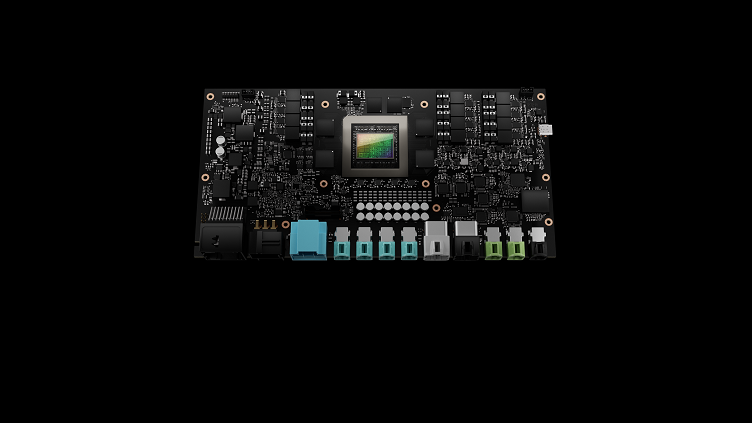
Nvidia Corp. has introduced its next generation centralized computer for autonomous vehicles called Drive Thor, which is capable of achieving up to 2,000 teraflops of performance.
The new GPU unifies automated processes into a single architecture for greater efficiency. These processes include:
- Assisted driving and parking
- Driver and occupant monitoring
- Digital instrument cluster
- In-vehicle infotainment
- Rear-seat entertainment
Drive Thor supports graphics and compute for advanced driver assistance systems (ADAS) and allows for concurrent time-critical processes to run without interruption. The chip will be available for automakers through 2025 models and will accelerate production roadmaps by bringing more performance and features to market in the same timeline, Nvidia said.
ZEEKR approved
Geely-owned automaker ZEEKR said it will integrate Drive Thor on its centralized vehicle computer for its next-generation electric vehicles (EVs) starting production in early 2025.
ZEEKR said the chip will provide luxury experiences with the latest technology and safety features that its customers will want in next generation EVs.
Thor features
Drive Thor supports multi-domain computing, isolating functions for automated driving and in-vehicle entertainment. Nvidia said dozens of electric control units are distributed typically in a vehicle to power individual functions, Drive Thor will consolidate the functions into a single system-on-chip (SoC) to simplify vehicle-design development resulting in lower cost, lower weight and fewer cables.
Nvidia said the platform is the first to incorporate an inference transformer engine, a new component of the Tensor Cores inside GPUs that can accelerate inference performance of transformer deep neural networks by up to nine times, which enables massive and complex artificial intelligence workloads associated with autonomous driving.
Additionally, Drive Thor has 8 bit floating point (FP8) capability. Nvidia said developers lose neural network accuracy when moving from 32-bit FP data to 8 bit integer format. The GPU features 2,000 teraflops of FP8 precision, allowing the transition to 8 bit without sacrificing accuracy.
