
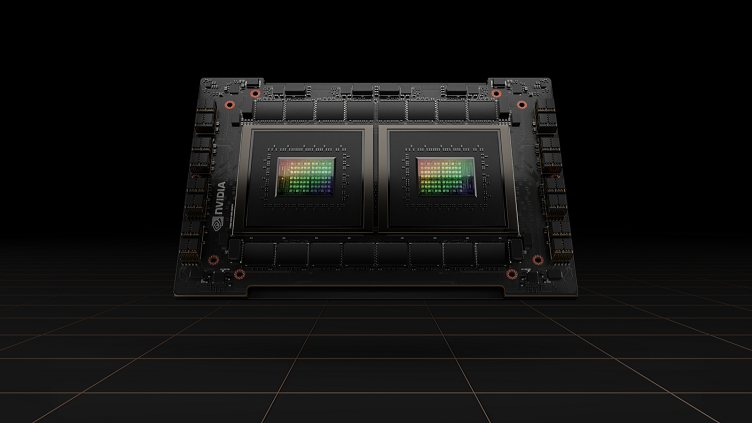
At GTC, Nvidia’s global artificial intelligence (AI) conference, the chipmaker introduced its Grace CPU superchip targeted at high performance computing (HPC), AI, data analytics, scientific computing and hyperscale computing applications.
Grace comprises two CPU chips connected over NVLink-C2C, a high speed, low-latency chip-to-chip interconnect based on Arm Neoverse discrete data center CPU designed for AI infrastructure and HPC.
Grace complements Nvidia’s first CPU-GPU integrated module called the Grace Hopper Superchip designed to serve giant-scale HPC and AI applications in conjunction with a Nvidia Hopper architecture-based GPU. Both superchips share the same underlying CPU architecture as well as NVLink-C2C interconnect.
High performance
The Grace CPU packs 144 Arm cores in a single socket and has a performance more than 1.5 times higher compared to the dual-CPU platforms.
Nvidia said the Grace CPU provides energy efficiency and memory bandwidth with a memory subsystem consisting of LPDDR5x memory with error correction code for speed and power consumption. The memory subsystem doubles the bandwidth of traditional DDR5 designs at 1 terabyte per second while consuming just 500 watts.
The CPU runs on Nvidia’s computing software stacks including Nvidia RTX, Nvidia HPC, Nvidia AI and Omniverse.
The superchip can be configured into servers as standalone CPU-only systems or as GPU-accelerated servers with one, two, four or eight Grace Hopper-based GPUs, depending on the specific workloads.
