
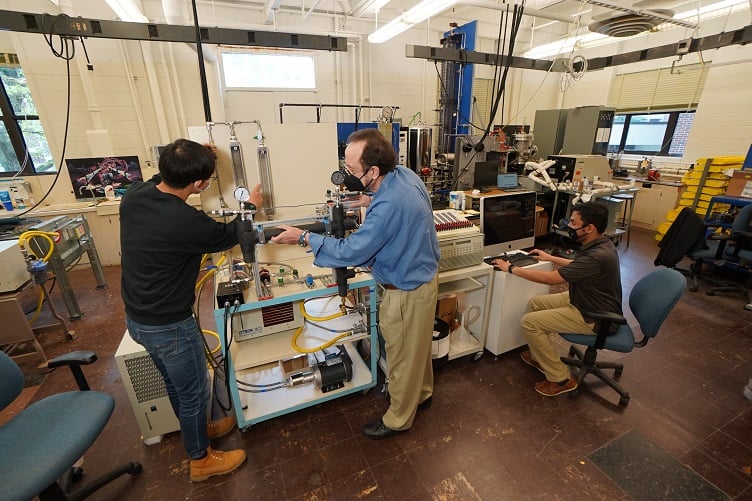
Ford Motor Company and Purdue University researchers have developed a new charging station cable that combined with faster charging technology could accelerate electric vehicle (EV) charging times significantly.
Today, chargers are limited in how quickly they can charge an EV battery due to the chance of overheating. Faster charging requires more current to travel through the charging cable, however, the higher the current, the greater the amount of heat that has to be removed to keep the cable operational.
Purdue researchers found an alternative cooling method that can help increase current. The cable uses liquid as an active cooling agent, which removes heat from the cable by changing phase from liquid to vapor.
The groups believe that one day it could deliver significantly more power to EVs, making the potential for faster recharging times possible if other charging technology enhancements are done in parallel. Eventually it could lead to recharging EVs being as quick as today’s gas station fill-ups.
“Electric vehicle charging time can vary widely, from 20 minutes at a station to hours on an at-home charging station, and that can be a source of anxiety for people who are considering buying an electric vehicle,” said Issam Mudawar, Betty Ruth and Milton B. Hollander Family professor of mechanical engineering, Purdue University. “My lab has come up with a solution for situations where the amounts of heat that are produced are beyond the capabilities of today’s technologies.”
Mudawar said his lab will begin testing a prototype charging cable in the next two years to determine more specific charge speeds for certain EV models.
The automotive market is in the largest transition perhaps in its history as all automakers are moving to electric cars as their primary models they will be selling as of 2030. To encourage more consumers to adopt electric vehicles and to meet the upcoming demand, more charging stations and charging network infrastructure will be needed.
(Learn more about EV charging on Globalspec.com)
While charging is deemed to be meeting the current level of demand, as many automakers expect their sales to be at least half of EVs in the next few years, that level won’t be able to sustain the influx of new EVs on the road. To keep pace with new EVs coming to market — which is an estimated 18 million by 2030 — a whopping 9 million stations will have to be installed in the next 10 years.
However, IHS Markit forecasts that the number of public and semi-public charging stations will increase at a compound annual growth rate (CAGR) of 28% between 2020 and 2030. In the U.S., the CAGR will be 32%. Public stations are available for use to any vehicle if it meets the charging requirements. Semi-public charging stations have some restriction on use — meaning a driver must buy something (at a hotel or shopping mall for instance) to use it.
