
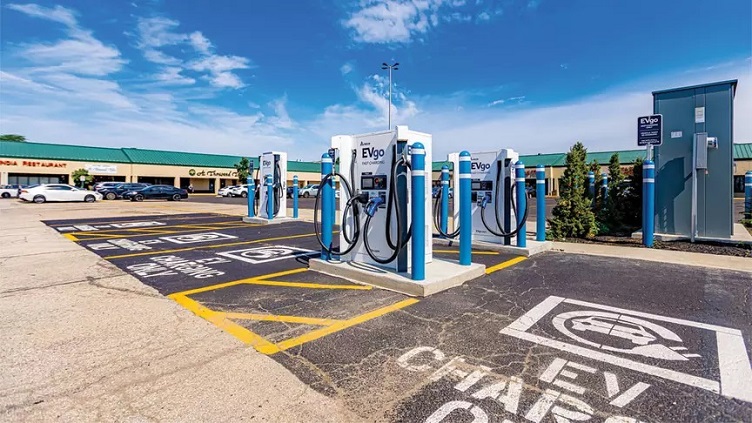
American Honda Motor Co. has signed agreements with electric vehicle (EV) charging companies EVgo and Electrify America that will allow its customers access to what it claims is the largest charging network in North America.
This includes access to Tesla Motor’s Supercharger stations after Honda said it will adopt the North American Charging Standard (NACS) beginning in 2025.
Additionally, more chargers will be available through a new joint venture that was formed by seven automotive OEMs to build a fast-charging EV network in North America. The system will create a leading high powered charging network able to use most public American DC fast chargers starting in 2024. The aim is to have 100,000 DC charge points available to these seven vendors by 2030.
New agreements
Beginning in early 2024, Honda’s new EV models will be able to use EVgo’s 900 public fast charging locations in North America that offer 350 kW fast chargers. EVgo’s APIs will be integrated directly into the HondaLink and Acura EV apps to allow both to locate charging stations, check availability and initiate a charging session.
The Electrify America agreement will offer Honda EV drivers access to 60 kWh of public charging included with charging packages from the company.
Why it matters
Charging stations and access to public charging is one of the top reasons that consumers are hesitant to adopt EVs as their next car purchase, according to J.D. Power. The other issue is that current EV drivers have had very bad experiences with current public EV charging stations.
Combined with a lack of overall public chargers, EV charging stations and access to these stations is a critical step to continue the automotive transition to electrification that is expected in the next 10 to 15 years. The U.S. Department of Energy said that there are 32,000 public DC fast chargers in the U.S. for use by the 2.3 million EVs on the road. This is a 72 vehicle per charger radio. So, it needs to get better and quickly to continue the momentum for EVs.
The National Renewable Energy Laboratory (NREL) said that at least 182,000 DC fast chargers will be needed to support 30 million to 42 million plug-in vehicles expected to be on the road by 2030.
