
Can 5G play a role in climate change reduction? The Canadian Wireless Telecommunications Association (CWTA) said the next generation wireless standard is critical to reducing the country’s carbon footprint by increasing energy efficiency of wireless networks and enabling new technologies to help reduce carbon emissions in vehicles, manufacturing, mining and other critical sectors.
A new report from the CWTA details how 5G can help Canada reduce its greenhouse gas emissions by 30% below 2005 levels by 2030, as part of the 2015 Paris Climate Agreement. While the country is making progress toward this goal, CWTA said, reaching even more rigorous targets set out by the Paris Agreement will be challenging.
"While we know from previous reports that 5G will foster much-needed economic growth and could create up to 250,000 new jobs in Canada, this study highlights the important role that 5G will have in fighting climate change by lowering carbon emissions, improving energy efficiency and enhancing precision for monitoring the environment,” said Tejas Rao, managing director and global 5G lead for Accenture’s network practice that conducted the study for CWTA.
To offset increases in energy consumption resulting from densifying networks to meet increasing consumer demand for mobile data, wireless carriers must look beyond 4G, CWTA said. 5G cell sites will help energy use in data transmission be 8% to 15% of what it currently is for a similar 4G cell site and millimeter wave (mmWave) technology will further reduce energy consumption to 1% to 2% of a 4G macro site.
According to experts, mmWave is expected to be the technology that will enable 5G to reach its full potential of delivering 10 times the download speeds, low latency and higher bandwidth for consumer and industrial applications. However, the technology currently has trouble connecting indoors. Without obstacles between mmWave and a mobile device, mmWave is fast. However, a tree, a building or walls could disconnect the service from the user. Sub-6 Ghz 5G technology can flow through obstacles easier and, consequently, represents most of the deployments that telecoms and equipment companies have rolled out thus far.
CO2 reduction
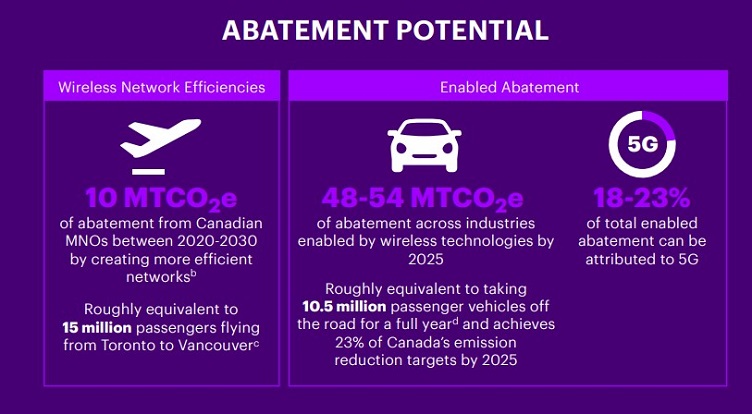
With a rapid rollout, 5G will enable up to 10 million tons of carbon dioxide (MtCO2) reduction between 2020 and 2030 compared to emissions without 5G, CWTA said. Wireless technologies allow industries to reduce their own emissions as well. CWTA said that by 2025, 4G and prior wireless technologies will generate up to 41.3 MtCO2 of abatement in Canada across various industries. The adoption of 5G will add between 6.4 and 12.2 MtCO2 of additional reduction during this period.
Of this, about 70% of this reduction in CO2 will come from three use cases: smart working, living and health; smart transportation; and smart buildings.
New use cases
Additionally, 5G will allow for a connected society unlike any previous wireless communications technology, CWTA said. This includes machines that connect to other machines at fast speeds with low latency.
New use cases will emerge because of 5G, resulting in substantial reductions in Canada’s greenhouse gas footprint. For instance, 5G will make it possible to connect transportation in three Canadian cities — Toronto, Montreal and Vancouver — enabling up to 0.83 MtCO2 abatement, CWTA said.
5G can also enable conferences and trade shows to be conducted virtually, which can reduce CO2 emissions from hotel room stays and travel emissions. CWTA estimates that Canadian conference emissions can be reduced by a cumulative 7,000 metric tons of CO2 over five years using 5G.
5G could also provide precise monitoring of the environment, combatting environmental degradation such as reduction of pesticides in agriculture or water quality testing for drinking water consumption. Precision agriculture enabled by 5G in oilseed farming in Canada could reduce pesticides by as much as 20%, leading to 15.6 tons of pesticide savings per year in Canadian oilseed farming.
For more information, see CWTA’s study called: "Accelerating 5G in Canada: The Role of 5G in the Fight Against Climate Change."
