
Sponsored Content
Electronics and Semiconductors
Choosing connectors for autonomous UxV applications
01 October 2020
Keeping up with the latest design requirements can be a challenge in the ever-changing world of technology. Startups in emerging markets struggle to standardize a particular component or interface. In the connector world, the choices seem endless. Autonomous UxV vehicles ̶ air (UAV), ground (UGV), surface (USV) and underwater (UUV) ̶ require an intricate combination of technologies such as radar, lidar, GPS, sonar, artificial intelligence, along with many sensors and cameras, all attempting to paint an instantaneous picture of the real world within an onboard computer.
Selecting connectors to interweave the various technologies can range from simple to complex. The simplest is if the OEM of the radar, lidar and GPS unit has selected the connector and one merely needs to identify the mating connector, or, even better, if the mating connector is supplied with pigtails. It gets more complex when several technologies need to be combined into a single connector to make it weatherproof, to streamline the cabling or just to create an intuitive solution where the connector can only be connected one way. Key requirements to consider are high speed data throughput, metal or plastic housings, environmental sealing, weight, and number of mating cycles. For fixed wing UAV applications, frequent set-up and breakdown may be required and wing sensors, control cables, pitot tubes and heater circuitry must have connectivity. Keying and color-coding may be needed where multiple similar connectors are used to avoid cross-mating.
Data speed and power
Connectors for high speed data are a critical consideration. With copper conductors, there is a limit to speed and distance for impedance-matched twisted pairs. Each segment of the connection, including the selection of the chips (physical layer), introduces additive latency.
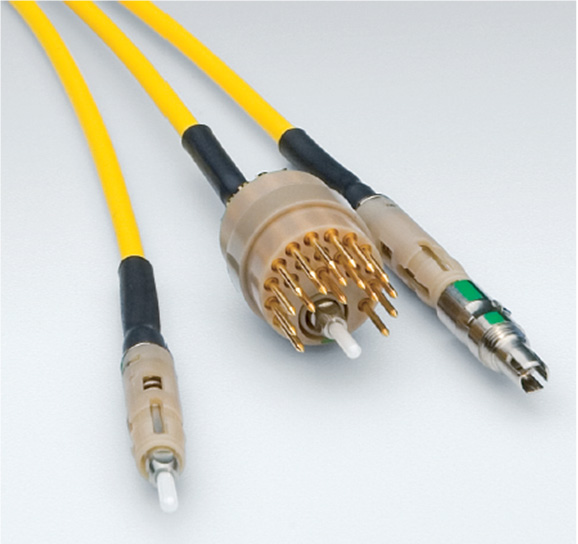 Figure 1: Left: Individual male fiber contact. Center: Fiber and copper combined in a single insert. Right: Individual female fiber contact. Source: LEMO USA
For mechanical lidar applications, some of the modules may need to be interconnected locally, or remotely throughout the vehicle. Fiber optics can assist with improving data speeds and bandwidths beyond copper’s capability, offering both increased speed as well as the ability to carry low power laser. If adding a fiber connector is necessary, considerations for insertion loss, return loss and power budgets must be made.
Connectors for power depend on the electrical requirements, but if there is an option to use a higher voltage, costs and overall installation weight can be minimized by using smaller conductor AW. Commonly, the recessed female contacts are chosen for the live side so that live conductors are not exposed when the connectors are un-mated.
Metal shielding
Ideally, each element could be directly integrated with each other, but in actuality, components or payloads need to be changed out frequently and quickly, requiring reliable and rugged connectors with excellent shielding. Connector housing materials are commonly made of metal to provide shielding. There are various levels of shielding and some connectors have the basic single-wall construction for most general-purpose applications. There are also connectors available with triple-wall construction that not only provide 360° protection for internal components, but that can also minimize EMI both from entering or exiting the connector. This can be especially critical for UAV applications, with close quarters to adjacent circuitry or payloads, or when the aircraft is subjected to powerful terrestrial radio transmitter signals or jammers.
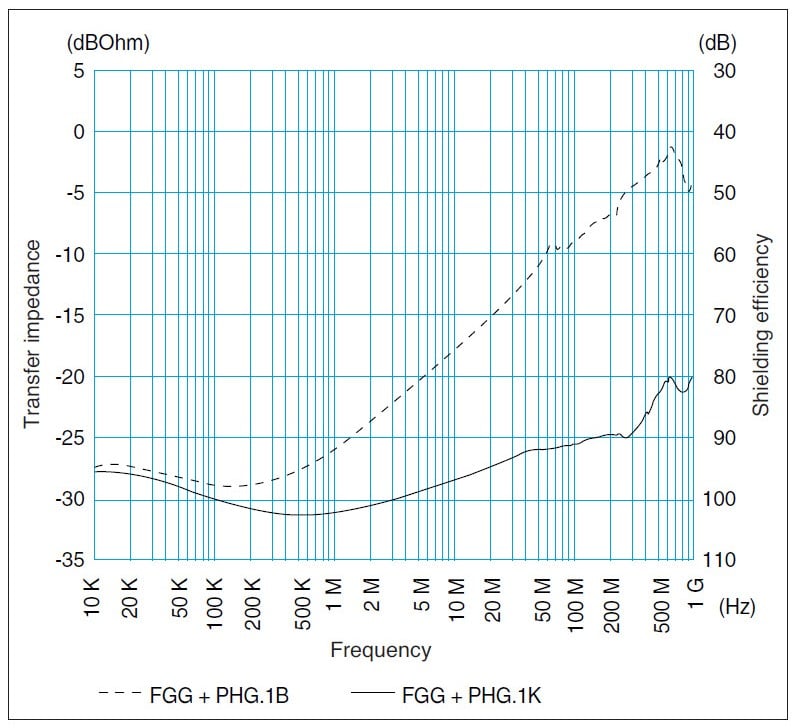 Figure 2: Shielding efficiency of triple-walled LEMO K and E series versus single-walled S and B series metal connectors. Source: LEMO USA
Harsh environment
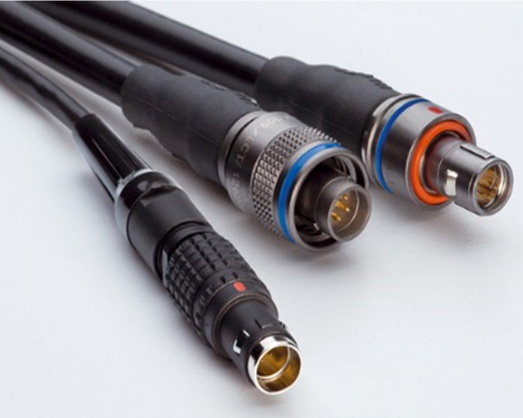 Figure 3: Harsh environment LEMO T, M and F series metal connectors. Source: LEMO USAIn most cases, the connectors will be protected from the elements within the UxV’s own housing. An IP50 rating is usually enough for these locations. However, once the connection is exposed to the elements an environmentally sealed connector with an IP67 or greater rating is needed. The sealing gland material must be resistant to fuels and other corrosive fluids. A connector housing with brass base material and plated with chromium can withstand 1,000+ hours of salt spray corrosion testing and a wide temperature range.
With the many choices available, fortunately most connector companies are available to assist in the selection process for a specific application. Contact LEMO USA for more information.
Powered by CR4, the Engineering Community
Discussion – 0 comments
By posting a comment you confirm that you have read and accept our Posting Rules and Terms of Use.
Advertisement
Advertisement
Popular News
Find Free Electronics Datasheets

Advertisement