
Researchers from Aalto University created a deep neural network that can produce realistic guitar sounds so convincing, blind listeners could not tell the difference. The model was created with a focus on real-time performance.
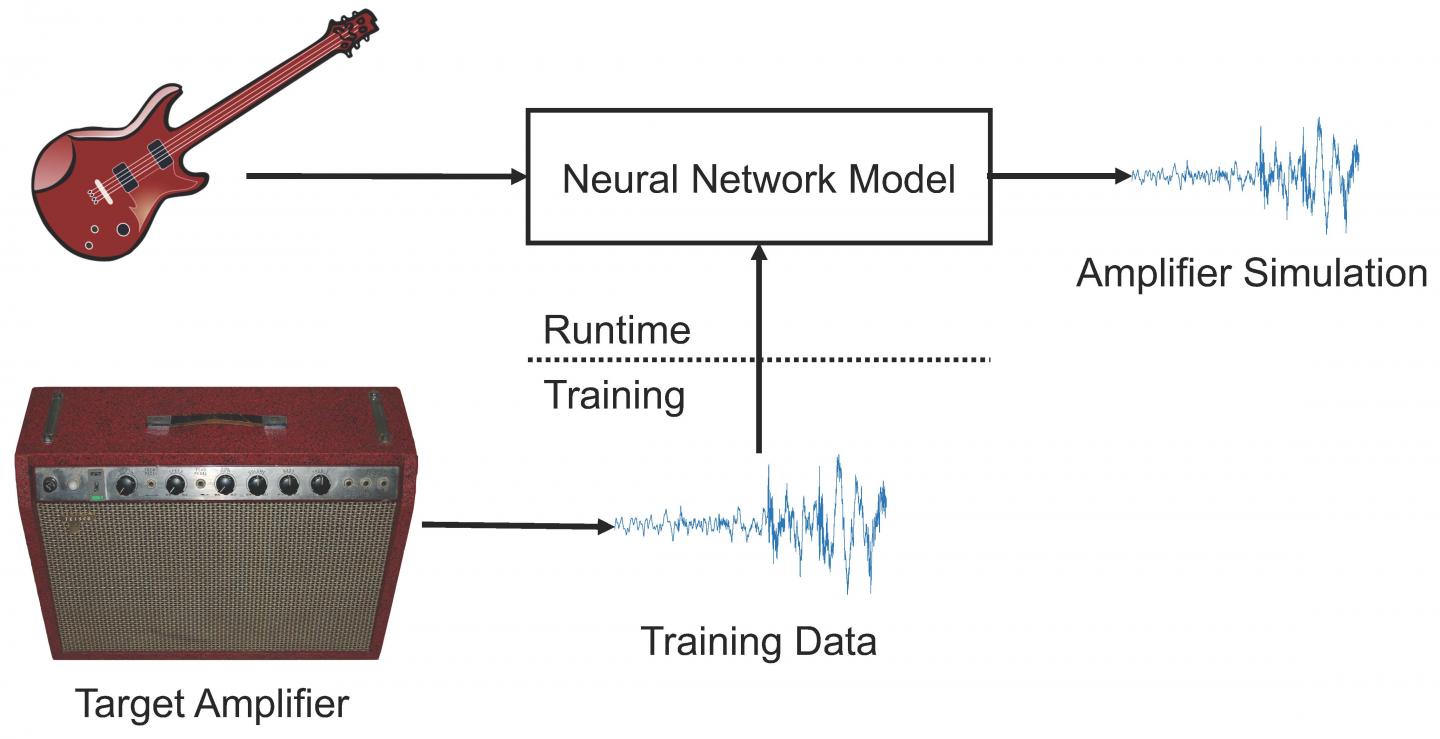 A basic schematic of the system. Source: Alec Wright
Along with the growth of digitized music, there is a need for digital imitations of analog audio effects, such as guitar amplifier sounds. Distorted guitar signal circuits use nonlinear components, like vacuum tubes, diodes and transistors. But the new neural network uses virtual analog (VA) modeling. The main objective of VA modeling is to create digital emulations of analog systems. The model eliminates the need to travel with bulky, expensive and fragile equipment. The equipment is replaced by software plugins that can be used on a desktop or laptop.
An amplifier’s circuitry can be simulated with circuit modeling techniques, but this method is too demanding for real-time processing. Additionally, a circuit model must be made for each amplifier being modeled, which is labor-intensive.
An alternative to the VA approach is black-box modeling. Black-box modeling is based on measuring a circuit’s response to some input signals, creating a model that replicates observed input-output mapping.
A study on the algorithms used a WaveNet convolutional neural network. Audio recorded from the target guitar amplifier is used to train deep neural networks. The model emulated the BlackStar HT5 Metal or Mesa Boogie Express 5:50 and tube amplifiers. This model is the first of its kind to trick blind-test listeners. Listeners were unable to tell the difference between a recording and a fake guitar sound.
In the future, guitarists may be able to simply plug into a laptop, run a deep neural network and a convincing guitar amp sound will be produced.
A paper on the new model was published in Applied Sciences.
