
The number of total knee replacement surgeries is on the rise but long-term functionality and pain-reduction outcomes remain unsatisfactory for many. Many of the surgeries are conducted to replace an older implant or one that has worn out. Since knee implants are prone to failure over time, monitoring their usage and performance can help patients control their physical activities and the designers of implants to improve their longevity.
Sensors are available to provide information about the status of a knee implant, but their reliance on battery 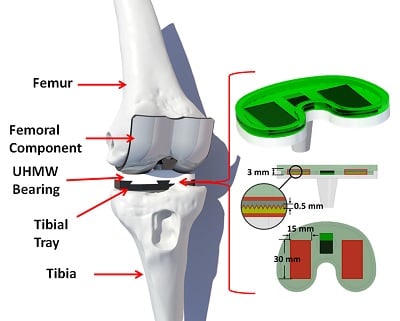 Schematic of a knee implant with embedded triboelectric energy harvester. Source: Sherry Towfighian, Binghamton Universitypower poses an additional need for replacement procedures. A self-powered knee implant with built-in sensors is under development to eliminate these issues.
Researchers from Binghamton University, Stony Brook University and the University of Western Ontario designed a triboelectric energy harvester and a knee implant with embedded sensors to track the implant’s condition. The sensor circuit requires only 4.6 microwatts and derives this operating energy from the implant’s motion. The walking motion of the average subject yields 6 microwatts, more than sufficient to power the sensors.
Testing demonstrated that the device can perform energy harvesting and load sensing at the same time. The harvested signal is rectified through a negative voltage converter rectifier and regulated through a linear-dropout regulator with a combined efficiency of 71%. The output of the regulator is used to charge a supercapacitor, and the stored energy is used for low-resolution sensing of the load through a peak detector and analog-to-digital converter.
The self-powered implants could provide feedback to doctors and extend implant life span.
