
Microorganisms are used in many industrial applications, including the production of fuels, chemicals, pharmaceuticals and foods. To ensure optimal performance, cell numbers and chemical byproducts are commonly monitored by taking periodic samples from microbial cultures to analyze the growth status of the cells. Hands-on sampling and analysis are time-consuming, labor intensive and costly, which may allow problems to persist for hours before they are detected.
A more cost-effective automated approach to monitor the energy levels of microbes uses electrochemical 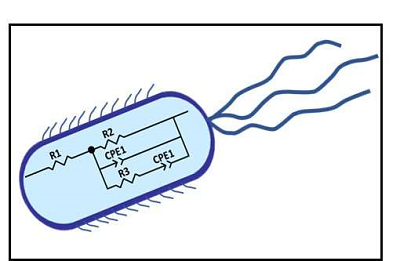 Electrochemical techniques provide opportunities to monitor microbial activity in real time, in-situ. This approach is expected to reduce analytical costs and generate an abundance of data for industrial bioprocesses. Source: Savannah River National Laboratory technology to assess cell status in real time. Electrodes are set at a specific reducing potential, enabling microbes to pull electrons as energy sources into their cells.
A small portion of the culture contacts the electrodes and serves as an early warning system for sub-optimal conditions. The energy taken into the microbes from the electrodes is reflected on a computer screen as an increase in electrical current. Such real-time tracking can help users maintain the right conditions for optimal microbial behavior.
Electrochemical impedance spectroscopy is also used to monitor the culture throughout the growth cycle. In this way, the microbial culture can be defined with an equivalent electrical circuit, which can then be used to fit impedance data and provide data that relates to the physiological status of the culture. This approach offers significant potential for decreasing analytical costs as well as automating bioprocesses.
Researchers from Clemson University, University of South Carolina, Savannah River Consulting and Savannah River National Laboratory contributed to this study, which is published in Applied Microbiology and Biotechnology Express.
