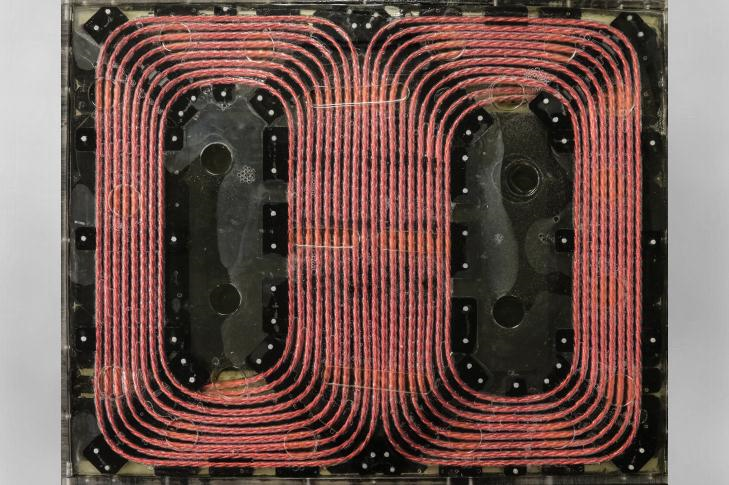
 Computer simulations were used to design coils that generate the magnetic field required for wireless power transfer. Source: ORNL
In 2016, U.S. Department of Energy Oak Ridge National Laboratory (ORNL) researchers demonstrated a 20 kW wireless charging system for vehicles with a 90% efficiency. The technology has now been upgraded to realize a 120 kW system, marking progress toward an option that could rival the convenience and speed of refueling at conventional gasoline stations.
During laboratory trials, a battery pack was charged by transferring power across a six-inch gap between two magnetic coils. The system’s power transfer efficiency of 97% is comparable to that of conventional wired high-power fast chargers.
A new coil design co-optimized with advanced latest silicon carbide power electronic devices was used to design the lightweight, compact system. Energy from the grid is converted to high-frequency AC, generating a magnetic field that transfers power across a large air gap. The energy is converted back to direct current after transfer to the secondary coil and stored in a vehicle’s batteries.
The development brings the agency closer to its goal of engineering a system that delivers 350-400 kW and reduces the charging time for electric vehicles to 15 minutes or less, and ultimately to dynamic charging at highway speeds via charging pads installed under roadways.
