
Sponsored Content
Electronics and Semiconductors
Providing Precision Power to the Connected Car Ecosystem
05 September 2018
Sponsored content
Connected vehicles are gaining prevalence on our roads and in our driveways. At the vehicle’s core are multiple disparate functions, including radar, lidar, infotainment, communications, cameras, interfaces and in-vehicle computing. Each function must communicate flawlessly with the others, which requires vast amounts of lightning-fast data processing. Advancements in vehicle interconnectivity necessitates ever-greater computing and processing capabilities.
This mission-critical collection of networked capabilities is tasked with 24/7 operation, often under extreme internal and external conditions. These technological functions combine today’s rapidly evolving solutions with decades-old legacy technologies without skipping a beat. The continued evolution of a better, safer and greener driving experience also relies on computing power, storage and an improved internal environment. The goal of a smarter and more ecologically friendly vehicle is driven by machine data, smart infrastructures and driver telematics. Stated annual industry goals for connected vehicles include the drastic reduction of fatalities, which, according to the National Safety Council in 2017, totaled more than 40,000 and injuries estimated at 2.75 million, in the U.S. alone.
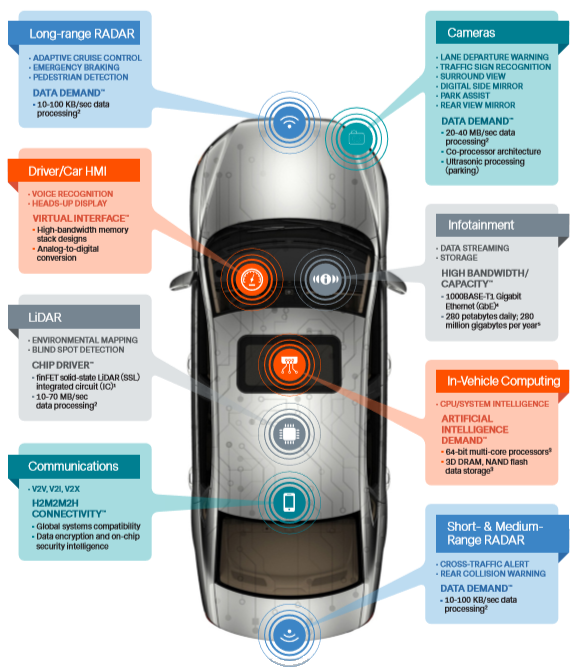 Figure 1. A multitude of vehicle sensors and systems must act extremely fast, efficiently and effectively in diverse operating conditions. Source: Advanced Energy
Making Sense of Data in Connected Technologies
At the heart of the connected car are the sensors and electronics that make up the system. These technologies produce vast amounts of data, derive useful and actionable information from that data and integrate it in real time.
Cutting-edge vehicle technologies and devices are developing new ways to not only connect the car internally, but also to connect the vehicle to its environment. This requires advanced power solutions that enable and support the external capabilities of memory, storage, data analytics and artificial intelligence.
Examples of environmental vehicle connectivity include:
- Vehicle-to-vehicle communication (V2V): The wireless transmission of data between motor vehicles to prevent accidents by exchanging position, speed, direction and alert data over a mesh network.
- Vehicle-to-cloud communication (V2C): Rapidly changing data passes through the cloud as a central hub so that it can be analyzed. The cloud is also central to building and developing the apps and programs used by operating vehicles to tailor the driving experience based on individual preferences.
- Vehicle-to-infrastructure (V2I): A network whereby vehicles and roadside units act as communication nodes that provide information, including traffic and safety warnings, necessary for smart cities to evolve.
Top-level integration of input from all of the different subsystems is necessary to make informed decisions and reach a correct interpretation of reality. All of this rests on the ability to rapidly process the data.
Cutting-Edge Logic and Processing-Power Integration
Critical power solutions across the vehicle require microprocessors (MPUs) for logic and storage memory devices. Innovative MPUs require advanced memory, both DRAM and flash, to properly function as part of the subsystem. In addition, legacy technologies that use older design ICs are still viable. It is the synergy of established technology and state-of-the-art power control systems that give rise to the advancements seen today.
Each of the technology segments requires extensive processing power to operate. As sophistication increases, power demand follows suit. Subsystems no longer stand alone, but must be fully integrated within the vehicle, and have the ability to process the data in real time.
Connected cars demand robust technologies, solid enough to survive the challenging automotive environment, while maintaining connectivity throughout the various systems.
What Does ‘Robust’ Really Mean?
Vehicles must operate flawlessly in a variety of environments, interrupted by long periods of inactivity. Electronics in the engine compartment consistently run at temperatures well over 120° F and in unclean conditions while continuing to provide failure-free operation. The absence of components robust enough to handle these environmental strains can result in potential injury to the driver, passengers or pedestrians, or damage to the vehicle and its surroundings.
The Role of Advanced Energy
McKinsey estimates a global market for connectivity components and services of $215 billion by 2020. The rapid evolution and growing dynamics of the connected vehicle, including innovative technologies and ever-greater computing power, is evident. Business Insider’s research concurs.
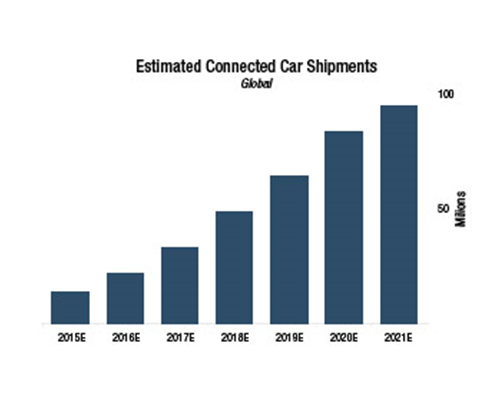 Figure 2. Ninety-four million connected cars are expected to be shipped in 2021, 82 percent of the entire market. This represents a compound growth rate of 35 percent. Data: Business Insider
Advanced Energy’s role in the value chain is to facilitate that transition: future-proofing the move to greater computing power and storage in all eight facets of the connected vehicle depicted in Figure 1. Advanced Energy provides power solutions, both legacy and state-of-the-art, that are key to this evolution.
The interconnectivity of our world is transforming this aspect of our lives, and technology is developing at the speed of thought. From key power solutions to the development of the latest ideas in advanced technology, Advanced Energy will continue to drive innovation into the future.
Powered by CR4, the Engineering Community
Discussion – 0 comments
By posting a comment you confirm that you have read and accept our Posting Rules and Terms of Use.
Advertisement
Advertisement
Popular News
Find Free Electronics Datasheets

Advertisement