
A bionic eye designed to aid the visually impaired moves closer to reality thanks to 3D-printing technology. A research group from the University of Minnesota followed up their development of a bionic ear a few years ago with the fabrication of a prototype artificial eye by printing electronics on a curved surface.
Researchers started with a hemispherical glass dome to show how they could overcome the challenge of printing electronics on a curved surface. Using their custom-built 3D printer, they started with a base ink of silver particles. The dispensed ink stayed in place and dried uniformly instead of running down the curved surface. The researchers then used semiconducting polymer materials to print photodiodes, which convert light 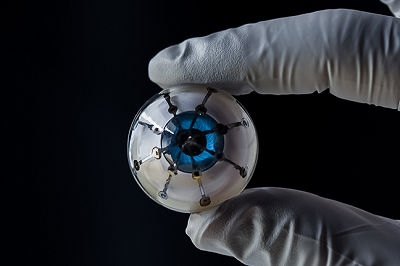 Researchers have fully 3D printed an image sensing array on a hemisphere, which is a first-of-its-kind prototype for a “bionic eye.” Source: University of Minnesota, McAlpine Groupinto electricity. The entire process takes about an hour.
Light receptors were applied to a hemispherical glass surface using a custom-built 3D printer. A base ink composed of silver particles dried uniformly instead of running down the curved surface. The last step in the one-hour production process entailed use of semiconducting polymers to print photodiodes to convert light into electricity. The resulting device demonstrated a light conversion efficiency of 25%, comparable to that of microfabricated counterparts.
This approach was further extended to create integrated multifunctional devices consisting of optically coupled photodetectors and light‐emitting diodes, demonstrating for the first time the multifunctional integration of multiple semiconducting device types that are fully 3D printed on a single platform.
Engineering a prototype with more efficient photodetectors, and devising a way to print on a soft material that could be implanted into a patient’s eye are the next goals for the research team.
