
A new device called a retroreflector, from North Carolina State University, has the ability to reflect sound better than any other device. It can reflect sound across an operating range of 70 degrees in either direction. The new device has a high potential for many applications in healthcare and more.
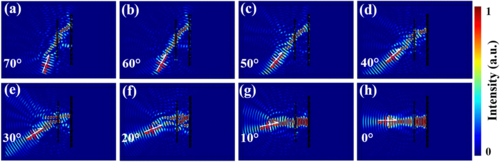 (a)–(h) The simulated total sound field energy profiles of the APR as a function of incident angle ranging from 0° to 70° in 10° steps. Source: North Carolina State University
"The technology makes use of two engineered materials," says Yun Jing, an associate professor of mechanical and aerospace engineering at North Carolina State University and co-corresponding author of a paper on the work.
"The first layer focuses the incoming sound waves onto a second layer, which then sends the sound waves back to their source. We were inspired by a similar approach used in optics research, but we think we are the first to use this technique in the acoustics field."
Older technology relies on a series of rectangular pins arranged across a material. Soundwaves bounced off the pins' sides to their bottom and then back to the original source. While this was relatively effective, the device is bulky and has a very limited range of angles for the sound to bounce back.
The retroreflector is a great improvement over this device. It is much slimmer than the previous devices and can work over a much wider range of angles. The prototype of the retroreflector has been tested and proven to be effective. At zero degrees, where the sound source is perpendicular to the surface of the device, 60 percent of the sound bounced off the device and back to the original source. At 70 degrees, which is the extreme end of the range, 40 percent of the sound was reflected back to the source. These developments may not seem like much, but they are actually a major improvement over the previous devices.
"We have a fully functional prototype now, and our next steps include fine-tuning the technology for use in specific applications, such as medical ultrasound," Jing says. "Frankly, we think there are likely applications that we haven't thought of yet."
The paper on this technology was published in the journal Physical Review Material.
