
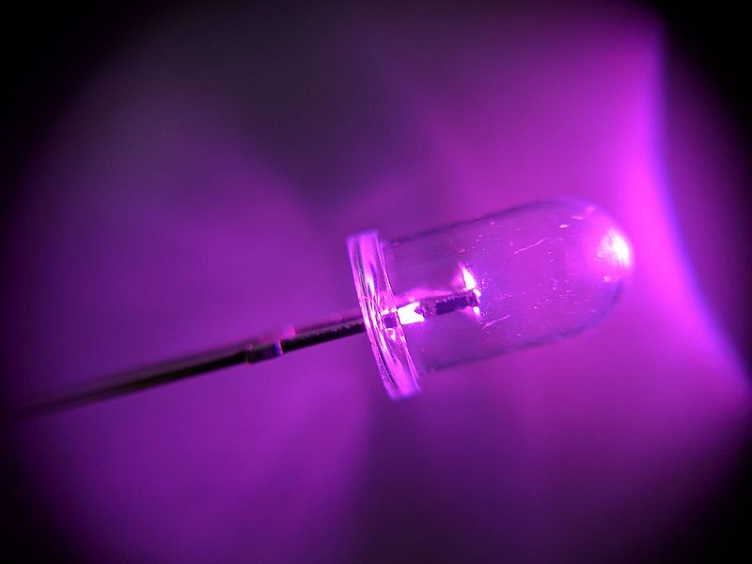
Light emitting diodes (LEDs) are a highly efficient light source. They have penetrated a wide range of markets from building and construction, transportation, medical devices, traffic lights and many other industrial applications, but why are they more efficient and why do they fail?
What is an LED?
LEDs are a two-lead semiconductor with a p–n junction diode that emits light when activated. Unlike incandescent bulbs and other traditional light sources, they don't have a filament and instead release photons from the p-n junction as electrons flow through the semiconductor material.
The p-n junction is constructed from a semiconductor such as gallium nitride (GaN), gallium arsenide (GaAs), gallium arsenide phosphide (GaAsP) or gallium phosphide (GaP). Each side of the junction is doped. A p-type semiconductor is made by doping the semiconductor with acceptor impurities while an n-type is made by doping with donor impurities.
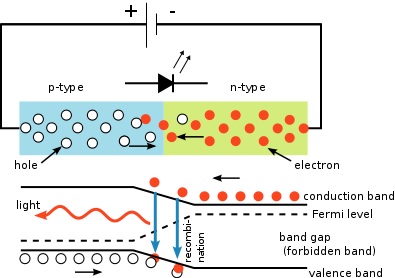 Schematic diagrams of Light Emitting Diodes (LED) Source: S-keiThe p-n junction is a forward biased junction. Electrons naturally diffuse, migrating toward the n-type material, and then when a forward-bias current is applied electrons cross the junction, filling in the holes in the p-type material and photons are released.
The wavelength of the emitted photon is a function of the bandgap in the active region of the semiconductor. A wider bandgap results in higher energy emission, or shorter wavelengths. The chemical composition of the semiconductor and sequence of the semiconductor layers within the active region influences the potential observed across the bandgap and is modified to emit a given wavelength.
LED Efficiency
The efficiency of the LED is described as the External Quantum Efficiency (EQE) and is the ratio of the number of photons emitted to the number of electrons passing through the p-n junction. Losses in efficiency come from several electron interactions that do not produce light.
The injection efficiency is a measure of the number of electrons passing through the device that are injected into the active region. Outside of the active region, no photons are generated. Then there is the internal quantum efficiency which is the proportion of electron-hole recombinations in the active region that are radiative and produce photons. Lastly, not all photons escape the device. The proportion of photons generated in the active region that escape from the device is referred to as the extraction efficiency.
The EQE of LEDs is roughly 40%, and while this is far greater than conventional light sources there is a substantial amount of energy loss that results in heat that must be dissipated.
LED Lifespan
The lifespan of an LED surpasses the short life of an incandescent bulb by thousands of hours. Despite the enormous gain in efficiency and life expectancy, LEDs will eventually fail and there are two primary classes of failure, those which are gradual and those which are catastrophic.
Catastrophic failure of LEDs is a rare occurrence, however, it can occur either when the LED is exposed to a high-voltage electrostatic discharge or when exposed to extreme temperature fluctuations.
High-voltage electrostatic discharges are rather common and an electrostatic charge of as much as 1.5 kV can be generated by simply walking across a carpeted room. If the die is exposed to these discharges it produces extremely localized heating, which can create perforations in the active media, leading to a short-circuit failure.
LEDs typically incorporate a transient-voltage-suppression (TVS) diode with a low breakdown voltage. The TVS diode acts to absorb transient spikes in voltage and can tolerate these peak pulses with a response time that is measured in picoseconds (ps).
Another mode of catastrophic failure stems from the number of different materials in the packaged component. Conductors, insulators and semiconductors all exhibit different coefficients of thermal expansion. The variance in material expansion leads to mechanical stress that can fracture wires or compromise contacts, causing catastrophic failure in the form of an open circuit.
Gradual degradation is by far the most common mode of failure for LEDs and the quality of the semiconductor material plays a large role in determining its lifespan. Manufacturing defects increase the likelihood that electron-hole recombination will give rise to non-radiative decay. Defects such as threading dislocation propagate due to both thermal cycling and electrical stress.
Structural defects can also occur and create paths for leakage current and open the way for reverse-bias current flow. When there is a reverse-bias current there is an injection of carriers through the active region that can generate new defects or cause existing defects to propagate. As the defect density increased it reduces breakdown voltage and impairs performance.
Modest amounts of gradual degradation cannot be detected by the human eye, but over time the luminous flux is reduced. The lifecycle of the LED is typically defined by the time for the luminous flux to drop below 70 percent of its initial value. This is considered the point of gradual failure for the LED.
Thermal management is essential to improving the lifespan of the LED and design engineers must consider conductive or even active cooling to address heat dissipation issues or otherwise seek out hardened components.
Resources:
